





I used to think sleep was just… shutting down. Like plugging your phone in at night. You go dark, you charge, you wake up. Done.
But the more you pay attention to how you feel mentally, the more you realize sleep is not passive at all. It is busy. It is maintenance. It is your brain doing an overnight rebuild while you are barely aware of it.
And yeah, it is kind of annoying that something as simple sounding as “go to bed earlier” can have such a huge effect on anxiety, mood, focus, even how resilient you feel when life gets loud. But that is the truth.
This is the science behind why sleep and mental wellness are so tightly connected. Not motivational poster stuff. Actual mechanisms. And then, some practical things that make the science work for real life.
Sleep is not one thing, it is a whole cycle
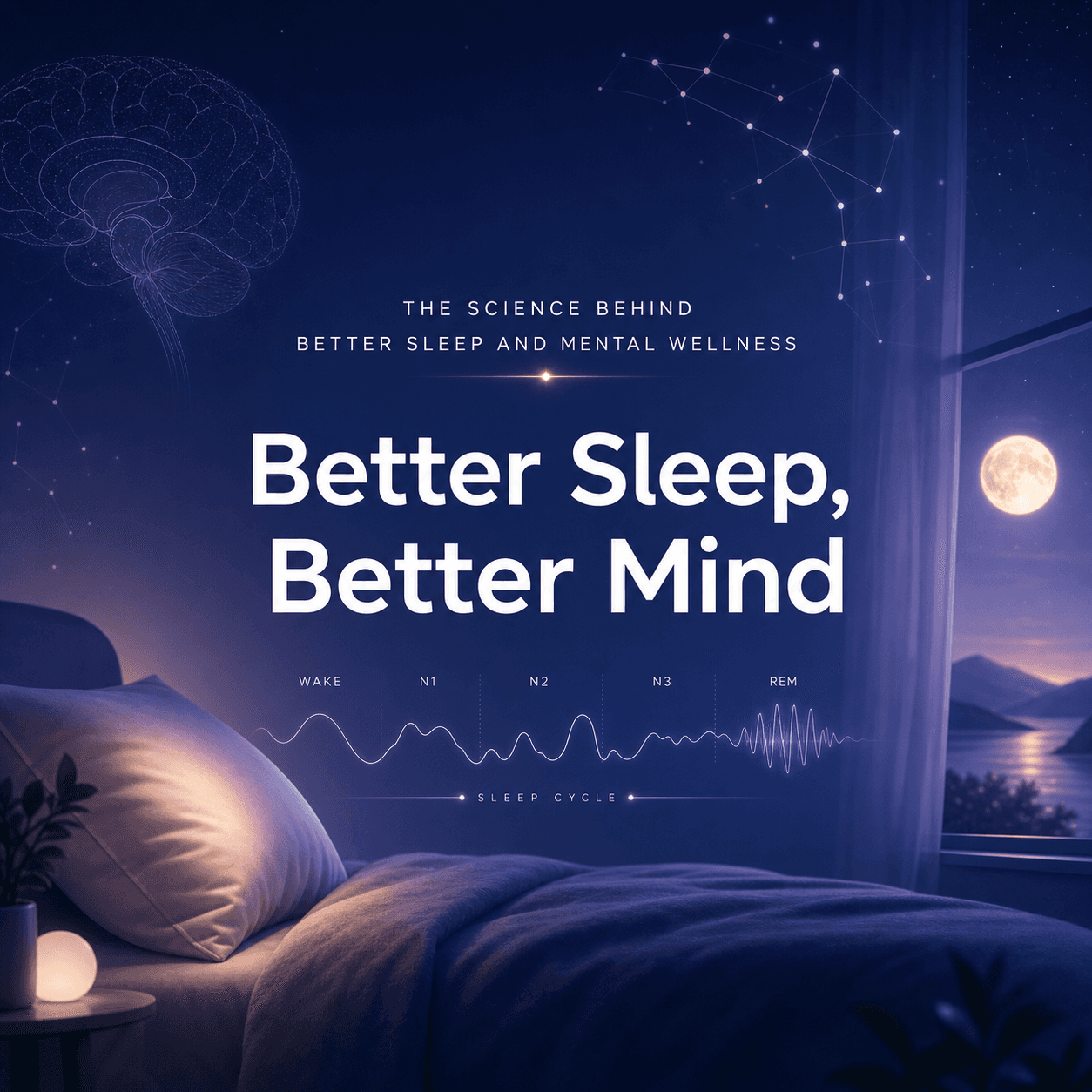
When people say “I slept 7 hours,” that number matters, but it is not the full story. Sleep has stages. Your brain moves through them in cycles, roughly every 90 minutes, though it varies.
There are two big categories:
- [NREM sleep](https://my.clevelandclinic.org/health/body/12148-sleep-basics) (non rapid eye movement), which includes light sleep and deep sleep
- REM sleep (rapid eye movement), where dreaming is most common
Each stage does different work. That matters for mental health because mood regulation, emotional processing, memory, and stress recovery are not all happening in one bucket. They are distributed.
Deep sleep is the physical repair and stress reset button
Deep NREM sleep is when your body leans hard into restoration. Growth hormone release, immune support, tissue repair. But mentally, deep sleep also seems tied to how well your brain recovers from stress.
If you are sleep deprived, deep sleep often gets compressed or fragmented. You might still spend time in bed, but it is not the same thing as stable deep sleep. And when deep sleep is low, people often report feeling more fragile, more reactive, more tired in a way caffeine cannot fix.
REM sleep is where emotions get processed, not deleted
REM sleep is the emotional “filing system” stage. One well supported idea is that REM helps your brain reprocess emotional experiences in a safer context. You revisit memories, but with less of the intense stress chemistry attached.
This is a big reason why poor sleep can make anxiety feel sharper the next day. It is not just tiredness. It is incomplete emotional processing.
Also, REM helps with learning and memory integration. So if you feel foggy, forgetful, or like you cannot find words after a bad night, that tracks.
The brain literally cleans itself during sleep
One of the most interesting discoveries in sleep science is the glymphatic system. Think of it as a waste clearance system in the brain.
During deep sleep, the space between brain cells slightly expands, and cerebrospinal fluid moves through brain tissue more effectively. That helps clear metabolic waste products.
Why does that matter for mental wellness?
Because when you do not sleep enough, you are not just “low energy.” Your brain is operating with more clutter. More inflammatory signaling, more stress reactivity, worse cognitive performance. Not forever, but day to day it adds up.
And if you are already dealing with depression, anxiety, burnout, ADHD like symptoms, or chronic stress… the extra load hits harder.
Sleep and mood share the same control centers
Sleep is regulated by several brain regions, but two systems are especially relevant to mental health:
- The hypothalamus (home base for circadian rhythm control and hormonal regulation)
- The limbic system, especially the amygdala (fear and threat detection) and prefrontal cortex (emotion regulation and decision making)
When you are sleep deprived, the balance shifts.
- The amygdala becomes more reactive. Threat detection ramps up.
- The prefrontal cortex becomes less effective at calming it down.
So you feel more anxious, more irritable, more emotionally intense. Not because you are weak. Because your brain’s braking system is tired.
This is one of the simplest explanations for why lack of sleep can make you cry easier, snap faster, assume the worst, or spiral from small triggers. Your brain is doing its job, just with less regulation.
Stress hormones and sleep have a messy relationship
Cortisol is your main stress hormone, and it follows a daily rhythm. It is supposed to rise in the morning to help you wake up and gradually fall at night to help you sleep.
Chronic stress disrupts that pattern. You can end up with cortisol too high at night, which makes it harder to fall asleep. Then you sleep poorly, and cortisol regulation gets worse. Loop begins.
Also, poor sleep increases sympathetic nervous system activity. That is the fight or flight system.
So if you feel wired at bedtime, like your body is tired but your brain is alert, there is often a physiology reason. You are not just “overthinking.” Your system is stuck in alert mode.
This can be further exacerbated by stress hormones that interfere with your ability to get restful sleep.
Sleep deprivation changes how you interpret the world
This part feels very real if you have ever been in a bad sleep week.
When you are low on sleep, your brain tends to:
- focus more on negative stimuli
- have weaker reward sensitivity (things feel less enjoyable)
- show lower frustration tolerance
- make social interactions feel harder
This is one reason sleep loss is linked with depression symptoms. Depression is not caused only by sleep problems, obviously. But sleep problems can amplify the emotional and cognitive patterns that depression feeds on.
Even one night of reduced sleep can shift mood. Several nights in a row, and you might start thinking something is seriously wrong with you.
Sometimes what is wrong is… you are just not sleeping.
Insomnia and anxiety reinforce each other
Insomnia is not just “I cannot sleep.” It is often a pattern: worry about sleep causes arousal, arousal prevents sleep, lack of sleep increases worry. Repeat.
The brain learns to associate the bed with struggle. The bedroom becomes a trigger.
That is why insomnia treatment is often behavioral and cognitive, not just pharmaceutical. CBT I (cognitive behavioral therapy for insomnia) is one of the most effective approaches because it breaks the learned loop.
If you only take sedatives without changing the pattern, you may still carry that fear of not sleeping. And fear is stimulating.
Depression and sleep can look like opposite problems
Sleep issues in depression are strange because they can go in two directions:
- trouble falling asleep, waking up early, restless sleep
- sleeping too much, feeling unrefreshed anyway
Both can happen. Both affect circadian rhythm and energy regulation.
The big point here is that sleep and mood are deeply intertwined at the biological level. They share neurotransmitter systems like serotonin, dopamine, norepinephrine, GABA. So disruptions in one domain often spill into the other.
Circadian rhythm is not a lifestyle trend, it is a mental health lever
Your circadian rhythm is your internal 24 hour clock. It helps coordinate sleep timing, hormone release, appetite, body temperature, and alertness.
When your circadian rhythm is misaligned, you can feel off even if you technically sleep enough hours.
Common causes:
- inconsistent sleep and wake times
- late night bright light exposure
- shift work or frequent time zone changes
- staying indoors all day with little daylight
Circadian disruption is associated with higher rates of mood disorders. Seasonal affective disorder is an obvious example, but even mild circadian drift can increase irritability and low mood.
The circadian system likes consistency. It is boring. But it works.
What happens when sleep improves? Your brain gets more flexible
This is one of the most underrated benefits. Better sleep tends to improve:
- emotional regulation
- cognitive flexibility (less stuck thinking)
- impulse control
- stress resilience
- motivation and energy
You still have problems, sure. But the problems feel more solvable. You feel more like yourself.
Sleep does not fix your life. It just gives you a brain that can actually handle it.
Practical ways to use the science without turning your life into a routine prison
You do not need a perfect night routine with lavender incense and a journal that costs $60. The goal is to support the systems that make sleep happen naturally.
Here are the high impact moves, and why they work.
1. Anchor your wake up time first
If you want to stabilize sleep, focus on getting up at a consistent time most days. Even if you slept badly.
Why? Because wake time anchors your circadian rhythm more reliably than bedtime. It also builds sleep pressure for the next night.
If you keep sleeping in after a rough night, you may delay sleep pressure and shift your whole rhythm later, which can keep insomnia going.
Not saying never sleep in. Just be aware it has a cost.
2. Get bright light early in the day
Morning light signals to your brain, “day has started.” It helps set the circadian clock so melatonin rises at night when it should.
Best case: outside light within the first hour of waking, even 10 to 20 minutes. Cloudy days still count. Window light is weaker, but better than nothing.
This one change can make evenings easier. You might not notice day one. Give it a week.
3. Dim lights at night, and yes screens matter
Bright light at night tells your brain it is still daytime. That delays melatonin release and shifts your clock later.
You do not need to live in darkness at 7 pm. But lowering overhead lights, using warmer lamps, and reducing intense screen time right before bed helps.
If you cannot avoid screens, use night mode, lower brightness, and try to keep the content calm. Doomscrolling is basically emotional caffeine.
4. Treat caffeine like a half day decision
Caffeine has a half life around 5 to 6 hours for many people, sometimes longer. So that 3 pm coffee might still be in your bloodstream at 9 pm.
If you struggle with sleep, try a simple experiment:
- no caffeine after 12 pm for two weeks
Not forever. Just test it. See what changes.
Also, caffeine can increase anxiety symptoms. So if you are prone to anxious spirals, caffeine timing matters even more than caffeine amount.
5. Keep the bed for sleep and sex, not stress
This is a key insomnia concept. If you use your bed for work, scrolling, worrying, debating, planning, your brain learns that bed equals alertness.
If you cannot sleep after about 20 to 30 minutes, get up and do something quiet in dim light. Read something boring. Sit. Breathe. Then return when sleepy.
It feels backwards, but it works because it retrains association.
6. Cool, dark, quiet is not a luxury, it is biology
Your body temperature naturally drops at night. A cooler room supports that process.
Most people sleep better when the room is cool, dark, and quiet. Blackout curtains, a fan, earplugs, white noise. Small upgrades, big payoff.
7. Alcohol is a sneaky sleep disruptor
Alcohol can make you fall asleep faster. That is the trap.
Later in the night it tends to fragment sleep, reduce REM, and increase awakenings. Many people wake at 3 am anxious and think it is random. Sometimes it is the alcohol rebound effect.
If mental wellness is your focus, alcohol is worth rethinking, at least on weeknights.
8. A short wind down routine helps the nervous system shift gears
You are basically transitioning from sympathetic mode to parasympathetic mode. From doing to resting.
This can be simple:
- 5 minutes of stretching
- a warm shower
- reading fiction
- breathing exercises
- writing down tomorrow’s top 3 tasks so your brain stops rehearsing them
The point is not perfection. It is repetition. Your brain starts to recognize cues.
9. If you have chronic sleep issues, do not just “try harder”
If insomnia lasts more than a few weeks, or you suspect sleep apnea, restless legs, or another sleep disorder, it is worth getting evaluated.
Sleep apnea especially is underdiagnosed, and it can seriously affect mood, anxiety, and cognitive function because it repeatedly disrupts oxygen and sleep quality.
Trying harder will not fix a breathing problem. Or a clinical insomnia loop. Get help if you need it.
The mental wellness part, in plain language
When sleep improves, you are not suddenly a new person.
You are the same person with:
- less emotional volatility
- more patience
- better attention
- fewer catastrophic thoughts
- more capacity to cope
Which, honestly, can feel like a personality change.
The science is clear that sleep is not optional for mental health. It is a foundation. Not the only foundation, but a big one.
So if you are trying to feel better mentally, and you have been skipping over sleep because it feels too basic… yeah. Go back. Recheck it. It is probably the lever you can pull without changing your whole life.
And the best part is you can start tonight. Not with a perfect plan. Just one small change.
Maybe you get outside for morning light tomorrow. Maybe you cut caffeine earlier. Maybe you dim the lights at night and stop feeding your brain chaos before bed.
Small boring things. Real effects. That is usually how this stuff works.
FAQs (Frequently Asked Questions)
Why is sleep more than just ‘shutting down’ at night?
Sleep is an active and busy process where your brain performs maintenance and overnight rebuilding. It’s not passive; during sleep, your brain works on mental wellness by regulating mood, processing emotions, consolidating memory, and recovering from stress.
What are the different stages of sleep and how do they affect mental health?
Sleep consists of cycles roughly every 90 minutes that include NREM (non-rapid eye movement) sleep—light and deep sleep—and REM (rapid eye movement) sleep where dreaming occurs. Deep NREM sleep supports physical repair and stress recovery, while REM sleep processes emotions and integrates memories, both crucial for mental health.
How does deep sleep contribute to stress recovery and brain health?
Deep NREM sleep acts as a physical repair and stress reset button by promoting growth hormone release, immune support, tissue repair, and helping the brain recover from stress. Lack of stable deep sleep can make you feel fragile, reactive, and tired in ways caffeine can’t fix.
What role does REM sleep play in emotional processing?
REM sleep serves as the brain’s emotional filing system by reprocessing emotional experiences in a safer context. It helps reduce intense stress chemistry attached to memories, aiding anxiety reduction and supporting learning and memory integration.
How does the brain clean itself during sleep and why is this important for mental wellness?
During deep sleep, the glymphatic system activates by expanding space between brain cells to allow cerebrospinal fluid to clear metabolic waste products. This cleaning reduces inflammatory signaling and stress reactivity, improving cognitive performance and protecting against daily mental strain.
Why does lack of sleep increase anxiety and irritability?
Sleep deprivation makes the amygdala (fear detection center) more reactive while weakening the prefrontal cortex’s ability to regulate emotions. This imbalance leads to heightened anxiety, irritability, emotional intensity, and lower frustration tolerance because your brain’s braking system is tired.