



I keep hearing the same sentence in a bunch of different places.
“Yeah I’m thinking of starting something online.”
It gets said like it’s a casual hobby. Like starting a newsletter is the same commitment as buying a yoga mat. But then you look around in 2026 and you realize something kind of wild has happened.
A lot of those people actually did it.
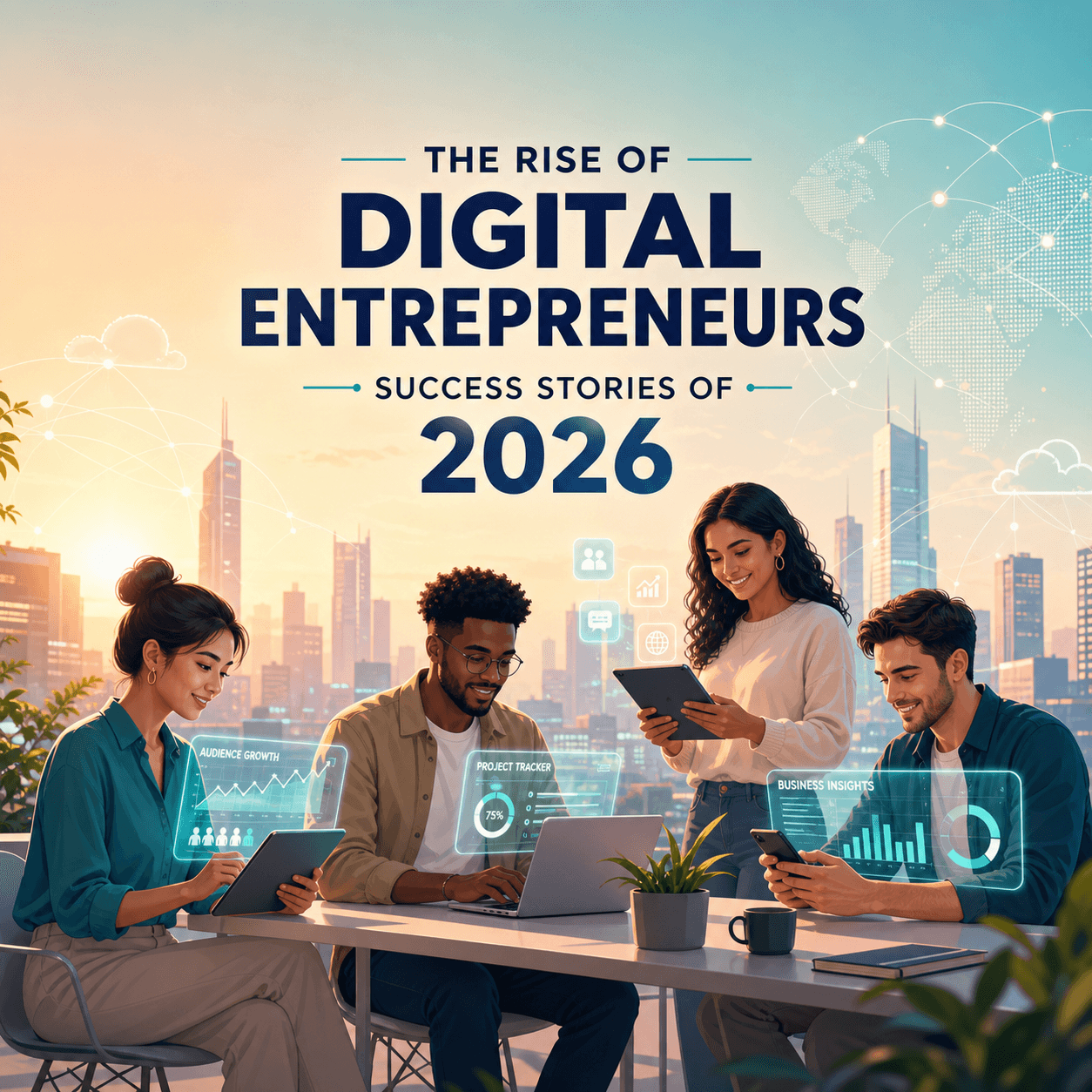
Not all of them, obviously. Plenty of folks still get stuck in the research loop and the “what niche should I pick” spiral. But enough people followed through that the vibe has changed. Digital entrepreneurship is not a quirky internet thing anymore. It’s a real lane. It’s normal. It’s showing up in family group chats, in small town cafes, in WhatsApp communities, in the way people talk about work.
And the most interesting part is how messy and human most of the success stories are. Not the fake ones where someone claims they made $300k in 17 days and the proof is a screenshot from a Stripe dashboard they could have Photoshopped in 90 seconds.
I mean the real ones.
People who built something useful. Or entertaining. Or oddly specific. And they kept going long enough for the compounding to kick in.
This is what the rise looks like in 2026.
Why 2026 feels different (it’s not just AI)
Yes, AI is a huge part of it. But if we blame everything on AI we miss the more practical reasons digital entrepreneurship is popping off right now.
Here’s what actually changed.
- Distribution got easier and weirder at the same time. You can grow on TikTok, sure. But also on LinkedIn carousels, Reddit threads, YouTube Shorts, niche podcasts, Discord servers, Pinterest, even inside AI search answers if your content is referenced enough.
- The “solo team” is real now. One person can do what used to require a designer, a copywriter, an editor, a video person, a VA, and a developer. Not perfectly. But good enough to ship.
- People trust individuals more than brands. If you have a face, a voice, receipts, and you show your process, you can win attention in a crowded market. A logo doesn’t hit the same.
- Micro payments and subscriptions are normalized. Paid newsletters. Templates. Small memberships. One time digital products. People will pay $9, $19, $49 without needing a sales call. That’s new-ish.
- Remote work changed expectations(source). Once you’ve tasted location freedom, it’s hard to go back. So a lot of people are building income that doesn’t rely on one employer.
- The App Store ecosystem continues to grow and evolve, providing more opportunities for digital entrepreneurs than ever before (source).
So with that context let’s talk about what success looks like this year.
Not theory but real stories from those who dared to venture into this online world and found their unique path to success.
Success Story #1: The “boring” spreadsheet that turned into a business
Maya was not trying to become a founder.
She was working in operations at a mid-size ecommerce brand, the kind of job where you are always dealing with inventory chaos and “why is this number different in Shopify vs the warehouse system” and other stuff that makes your brain melt a little.
She built a spreadsheet to track returns and map them to actual margin loss. Nothing sexy. No fancy branding. Just a clean sheet with a few formulas, a dashboard view, and a weekly summary email template.
A friend at another store asked for it. Then another. Then it turned into a Notion page with a Loom walkthrough. Then a Gumroad listing. Then an actual product.
In 2026 her setup looks like this:
- A $39 template bundle (spreadsheet, Notion tracker, scripts for customer support tags)
- A $12/month “ops club” subscription with monthly office hours and updated templates
- A tiny affiliate partnership with two ecommerce tools she actually uses
Her growth channel is not ads. It’s not even social media in the traditional way.
It’s SEO plus being helpful in public.
She answers questions in Slack groups for ecommerce operators. She writes short posts like “here’s how we reduced return losses by 18% without touching ad spend” and people DM her. She also gets cited inside AI search responses because her guides are specific and structured.
The thing I love about this story is the lesson everyone ignores.
Boring is a feature.
If you solve a painful operational problem for people who already have money, you don’t need to go viral. You just need to be easy to trust.
For instance, reducing return losses significantly can be achieved without increasing ad spend, which is exactly what Maya did with her innovative spreadsheet solution.
Success Story #2: The creator who stopped chasing followers and built a tiny product
Jules had a decent following in 2024. Around 70k on TikTok, and a YouTube channel that did fine.
But the income was inconsistent. Some months were great, some months were “why am I doing this”. Brand deals felt random. The algorithm felt like a moody landlord.
So in late 2025 Jules did something quietly smart.
They looked at the comments and DMs and noticed the same request over and over.
“How do you edit like that?”
Not “what camera do you use”. Not “what’s your niche”. Editing.
So Jules made a simple product:
- a pack of editing presets
- a short course called “Clean Cuts” (under 90 minutes total)
- a little library of sound design clips
And instead of trying to build a huge funnel, they did the obvious thing. They made three videos showing the before and after, and pinned them. That’s it.
In 2026 the business looks like:
- $29 preset pack
- $79 mini course
- occasional live workshops for $49
The audience is smaller now but the income is steadier. Which sounds boring but it changes your whole mental state. You stop panic posting. You stop chasing trends you don’t even like. You start making content that actually matches the product.
The lesson here is subtle.
A lot of creators in 2026 are not “influencers”. They are educators with receipts. They sell tools that speed up results. And they do it without pretending to be gurus.
Success Story #3: The freelancer who built a productized service in a weekend
Amir was a freelance web designer. Good portfolio, decent clients, always booked. But he was exhausted. Every project felt like starting from scratch, because every client thinks their website is a special snowflake.
In January he decided to run an experiment.
He productized one offer:
“Landing page in 72 hours for $1,200. One revision. Copy included. No discovery call.”
It sounds risky because people are used to freelancers doing long calls, custom scope, proposals, all that. But in 2026, a lot of buyers actually like clarity.
Here’s how he made it work:
- He built a strict intake form with examples
- He used a fixed design system, same components every time
- He wrote copy using a structured framework, then edited it like a human (important part)
- He posted daily teardown threads on LinkedIn showing what makes landing pages convert
In four weeks he was booked out. Then he hired a part time developer. Then he raised the price.
He still does design. But he’s not reinventing his process for every client. He’s selling speed and certainty.
The lesson is not “productize your service” because everyone says that.
The real lesson is that constraints make digital businesses scalable. The more choices you remove, the easier it is to deliver reliably.
Success Story #4: The niche newsletter that became a paid community
Lena used to work in HR.
She got laid off, and instead of immediately hunting for another corporate role, she started writing a newsletter about what she knew. Specifically, how hiring actually works behind the scenes. The stuff job seekers never hear.
She wrote like a real person. Short paragraphs, a bit sarcastic sometimes, lots of screenshots, real examples.
At first the newsletter was free. Then she added a paid tier for:
- resume feedback templates
- interview question banks
- a monthly “job search plan” workshop
- a community channel for accountability
The newsletter didn’t explode overnight. It grew steadily. Mostly through referrals because every issue was shareable. Friends would forward it with “this is the only job advice that feels real”.
In 2026 she’s doing:
- free newsletter
- $8/month paid tier
- a higher tier where she does small group sessions
What’s interesting is how she positioned herself. She never claimed to be a career guru. She was just honest. She’d say things like “this resume trick won’t work for senior roles, but for entry level it’s gold” which made people trust her more.
That’s a theme you see everywhere now.
Honesty sells. Not in a moral way. In a practical way.
Success Story #5: The local business that went digital and doubled revenue
Digital entrepreneurship is not only for people who want to be “online”.
Sam runs a small fitness studio. In person classes. Great community. But it capped out because of room size, time slots, and burnout.
In late 2025 Sam started recording short mobility programs for clients who missed classes. It was supposed to be a bonus.
People asked if they could buy it without joining the studio. So Sam built a simple digital offer:
- a 21 day mobility plan
- a beginner strength program with minimal equipment
- a membership library with new routines added weekly
The marketing strategy was not complicated. Sam just documented real client journeys (with permission). Before and after. Little check ins. Simple.
In 2026 this studio is still local. But the digital side now brings in a meaningful chunk of revenue. And Sam’s schedule is calmer because not every dollar depends on physically being in the room.
The lesson is one I think a lot of people miss.
If you already have a real world skill and real world results, going digital is less risky. You are not guessing. You are packaging something that works.
What all these 2026 success stories have in common
Different niches. Different personalities. Different business models.
But the patterns show up fast if you look for them.
1. They didn’t start with a “brand”. They started with a problem.
Most successful digital entrepreneurs this year didn’t begin with a color palette and a tagline.
They started with:
- a painful task
- a repeating question
- a frustrating workflow
- a skill people wanted faster
The brand came later. And honestly, sometimes it never became a “brand” in the traditional sense. It became a reputation.
2. They built in public, but not in a cringey way
“Build in public” got a bad reputation because people turned it into daily vanity updates.
But the good version is simple:
Show your process. Show what you tried. Show what failed. Then show what worked.
That’s it.
People follow because it’s useful. And because it makes the creator believable.
3. They chose distribution channels that matched their personality
This one is huge.
The entrepreneurs who last are not forcing themselves to dance on Reels if they hate it. They pick a channel they can stick with.
- Writers win with newsletters and SEO.
- Talkers win with podcasts and short form video.
- Visual people win with YouTube, Pinterest, Instagram.
- Community builders win on Discord, Slack, Circle, Geneva.
Consistency beats intensity. Especially in 2026 where everyone is tired.
4. They used AI as a helper, not a personality
The entrepreneurs winning right now are using AI like a set of hands.
Summarize this. Draft that. Brainstorm ideas. Outline. Repurpose.
But they still do the human part:
- the judgment
- the taste
- the editing
- the real examples
- the “this is what I actually think” layer
When someone’s content feels like an AI smoothie, you can tell. And people bounce.
5. They focused on trust faster than they focused on growth
This is the quiet shift in 2026.
A lot of people would rather have 1,000 true fans who pay and refer than 100,000 followers who forget them next week.
Trust comes from specificity. Proof. Showing your work. Being consistent long enough that people relax.
It’s not a hack. It’s time plus clarity.
The new digital entrepreneur stack in 2026 (simple, not fancy)
If you’re curious what tools people are actually using, it’s usually a boring stack. Which is good. Boring means reliable.
A common setup looks like:
- A website or landing page builder (or just a simple link in bio page to start)
- Email platform for a newsletter
- A checkout platform for digital products
- A community platform if needed
- AI tools for drafting, editing, repurposing
- Analytics that are basic, not obsessive
And then the real “stack” is habits:
- writing weekly
- shipping monthly
- listening to customers
- refining the offer
Tools are not the magic.
The part nobody wants to hear (but it’s true)
Most of these stories didn’t happen in 30 days.
Even the “weekend product” one, the person had years of skill behind it. The weekend was just packaging.
Digital entrepreneurship in 2026 is more accessible than ever, yes. But it still has rules.
You need to show up. You need to make something people want. You need to market it without hiding. You need to keep improving it.
And you need to be okay with it being a little awkward at first.
Because it will be.
Your first landing page will look kinda weird. Your first sales page will be too long. Your first videos will feel stiff. Your first offer will be underpriced or confusing.
That’s normal. That’s the process.
What you can take from these stories (a simple starting plan)
If you’re sitting there thinking, okay but what do I actually do this week, here’s a practical way to start without overcomplicating it.
- Pick one problem you can solve. Not a niche. A problem. Something you can explain in one sentence.
- Create a small offer. Template, checklist, mini course, audit, productized service. Keep it tight.
- Write or post about it for 30 days. Show examples. Answer questions. Share your process.
- Collect feedback fast. Every DM and comment is product research.
- Improve the offer. Add clarity, proof, better onboarding. Raise the price when it works.
That’s basically how most “overnight successes” are built now. Quietly. Repeatedly.
Let’s wrap up
The rise of digital entrepreneurs in 2026 is not really about people becoming millionaires on laptops. Some do, sure. But that’s not the core story.
The core story is that more people are building small, real businesses online.
A spreadsheet that fixes a painful workflow. A tiny editing product that pays rent. A productized service that stops the freelancer grind. A newsletter that turns into a community. A local studio that goes digital and finally breathes.
It’s practical. It’s human. It’s imperfect.
And if you’re thinking about starting, you don’t need to “go big” first.
Just go real. Solve something. Ship it. Talk about it. Improve it.
Then do it again.
FAQs (Frequently Asked Questions)
Why is 2026 considered a breakthrough year for digital entrepreneurship?
2026 marks a significant shift where digital entrepreneurship becomes mainstream, fueled by easier and more diverse content distribution channels, the rise of solo entrepreneurs handling multiple roles, increased trust in individuals over brands, normalization of micro payments and subscriptions, changing remote work expectations, and the evolving App Store ecosystem.
How has content distribution changed to support digital entrepreneurs in 2026?
Content distribution has become easier and more varied with platforms like TikTok, LinkedIn carousels, Reddit threads, YouTube Shorts, niche podcasts, Discord servers, Pinterest, and even AI search results serving as channels where entrepreneurs can grow their audiences effectively.
What does the term ‘solo team’ mean in the context of digital entrepreneurship?
The ‘solo team’ refers to an individual entrepreneur who can perform multiple roles such as designer, copywriter, editor, video producer, virtual assistant, and developer well enough to create and ship products independently without needing a full team.
Why do people trust individual creators more than traditional brands today?
People tend to trust individuals who show their face, voice, transparent processes, and verifiable results over faceless logos because authentic personal connections and demonstrated credibility resonate more in crowded markets.
What are some examples of successful digital products mentioned in the 2026 digital entrepreneurship landscape?
Examples include Maya’s operational spreadsheet turned into a $39 template bundle with a $12/month subscription model for ecommerce operators and Jules’ simple product addressing frequent audience requests about video editing techniques—demonstrating practical solutions rather than viral gimmicks.
How have remote work trends influenced the rise of digital entrepreneurship?
Remote work has shifted people’s expectations toward location freedom and independence from single employers. This motivates many to build online income streams that offer flexibility and control over their professional lives outside traditional employment models.