



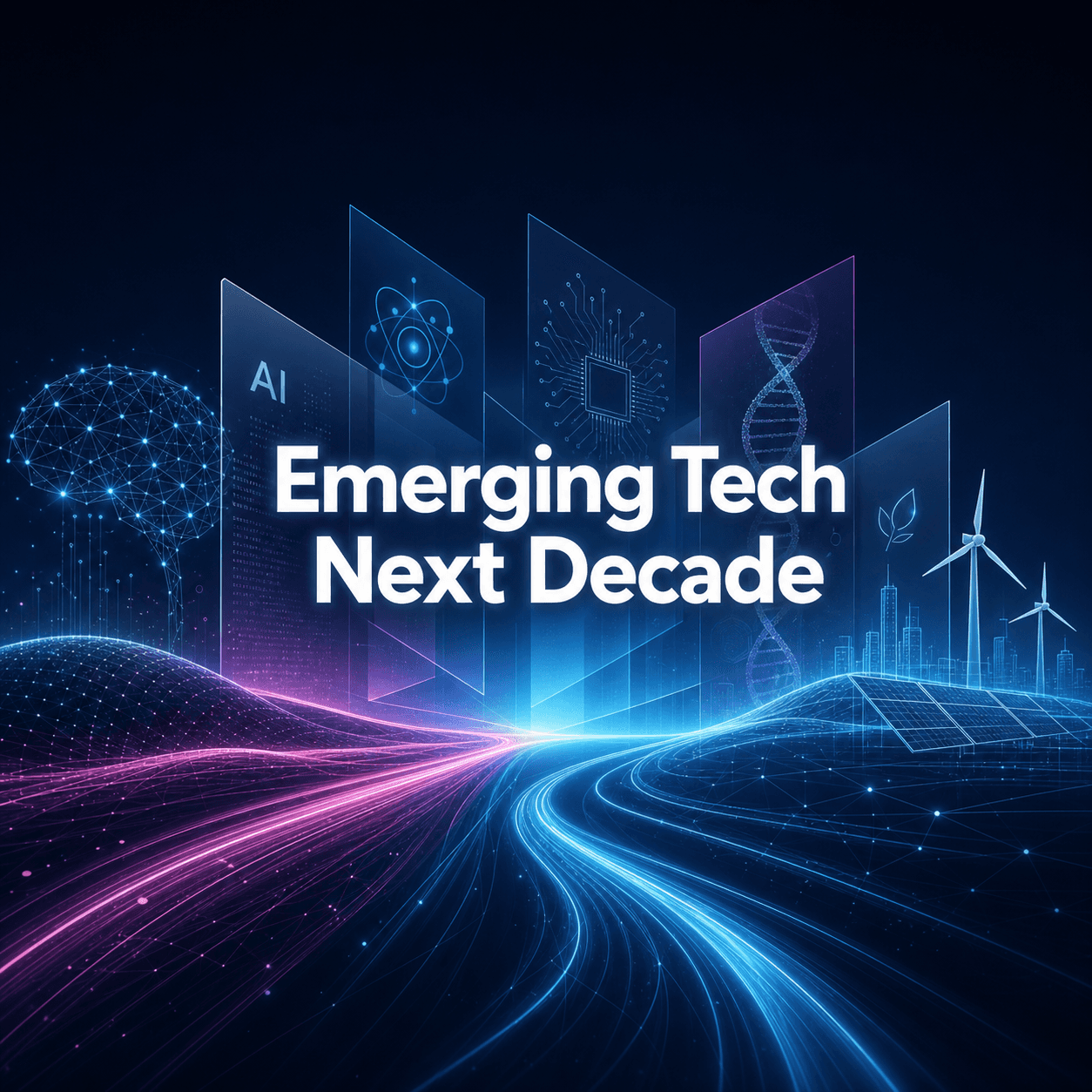
Ten years is a weird amount of time.
It’s long enough that your phone will feel ancient, and some job titles will sound like jokes. But it’s short enough that most of the “future tech” we talk about is already here, just… uneven. Expensive. Clunky. Stuck in labs. Or quietly rolling out in one industry while everyone else ignores it.
So instead of doing the usual sci fi list, I want to focus on the technologies that are actually on a path to matter. The stuff that will reshape work, health, security, energy, manufacturing, even how we trust what we see online.
Not all of these will “change everything” overnight. That’s not how it works. It’s more like compound interest. A bunch of small shifts, then suddenly you look up and the world is running differently.
Let’s get into it.
AI goes from “chatting” to doing real work
The last couple years made AI feel like a content machine. Text. Images. Video. A constant stream of demos.
The next decade is more about AI as labor. Not just generating words, but completing tasks end to end. Booking. Planning. Negotiating constraints. Monitoring systems. Taking action inside tools. And yes, messing up sometimes, which is why the surrounding infrastructure matters.
A few sub trends inside this that are bigger than they look:
Agentic workflows. Instead of one prompt, you get a system that can break a goal into steps, call tools, check results, and keep going. Think “run my monthly reporting, flag anomalies, draft the explanation, open tickets for the issues”. Less magic chatbot, more junior operator that never sleeps.
On device AI. More inference happening locally on phones, laptops, cars, and industrial machines. That matters for latency, cost, privacy, and reliability. Also it reduces the “send everything to a data center” vibe, which people are getting tired of.
Smaller, specialized models. We’ve been hypnotized by giant models. But in real businesses, a smaller model trained on your data and tuned for your workflow can outperform a general model, and it’s cheaper to run.
AI governance and auditing. Not exciting, but necessary. If AI is approving loans, detecting fraud, advising clinicians, scheduling maintenance for a power grid… you need traceability. You need evaluation, logs, red teaming, bias testing. This becomes an industry.
The shape of work changes here. Some roles shrink. Some get weirdly powerful. “One person with good systems” becomes a pattern in every department. And companies that treat AI like a toy will look slow.
Robotics finally leaves the cage
Robots have been “the future” for decades. But most robots were trapped in structured environments. Factory cells. Warehouses with tape lines. Places where nothing unexpected happens.
That is changing. The next decade is about robots operating in messy human spaces. Not perfectly, not everywhere, but enough to matter.
What’s driving it is the stack coming together:
- Better perception from cameras and sensors
- Cheaper compute at the edge
- Improved motor control and dexterity
- Better simulation and training environments
- And of course, AI that can interpret goals and context
We’ll see robots in a few categories:
Warehouse and logistics. This keeps accelerating because the ROI is obvious. Picking, sorting, loading, inventory scanning, last meter movement in micro fulfillment centers.
Field robotics. Agriculture bots that weed, monitor crop health, harvest certain crops. Construction robots for surveying, site scanning, brick laying, rebar tying. Infrastructure inspection robots crawling pipelines and bridges.
Care and service robotics. Not the humanoid-butler fantasy. More like assistive devices, lifting aids, cleaning robots that can handle complex layouts, delivery bots in hospitals, and companionship or monitoring systems for elder care.
And yes, we’ll get more humanoid demos. Some will even be useful. But the real impact will come from unglamorous robots doing repetitive physical work where labor is scarce, dangerous, or expensive.
Spatial computing gets practical, slowly
AR and VR have been “next big platform” talk for a long time. The problem wasn’t imagination. It was hardware comfort, battery, field of view, and a lack of everyday reasons to wear something on your face.
The next decade doesn’t necessarily mean everyone wears glasses all day. It means spatial computing becomes normal in specific contexts first, then bleeds outward.
Where it sticks:
Training and simulation. Mechanics, surgeons, pilots, factory technicians. When mistakes are expensive, immersive practice is a cheat code.
Design and collaboration. Architects, industrial design teams, product prototyping. Being able to walk around a digital twin, scale it, annotate it, and review changes in context is genuinely useful.
Remote assistance. A technician in the field can stream what they see and get guidance with overlays. This already exists, it just gets better, lighter, cheaper.
Entertainment and fitness. This is where adoption often starts because people will tolerate some friction for fun.
Also important: spatial mapping plus AI. Once devices understand rooms and objects, the interface changes. Your environment becomes part of the computer. That’s the actual shift.
Biotech and gene editing move from rare to routine
This is the one that feels like it should be slower. And yet, biotech keeps speeding up.
Sequencing got cheap. Lab automation improved. AI is helping with protein design and drug discovery. mRNA platforms proved they can be deployed fast. And CRISPR and other gene editing tools keep getting more precise.
In the next decade, biotech shapes the world in a few big ways:
Personalized medicine. Treatments based on your genetics, biomarkers, and disease subtype. Cancer care keeps moving this way. So do rare diseases.
Gene therapies. Still expensive and complex today, but the pipeline is real. As manufacturing improves and delivery methods improve, more conditions become treatable.
Synthetic biology. Engineering microbes to produce chemicals, materials, fuels, fertilizers, and pharmaceuticals. This can reduce reliance on petrochemicals in some sectors. Not all, but enough to shift supply chains.
Diagnostics everywhere. Faster testing at point of care, at home, in pharmacies. Cheap sensors plus better interpretation models. This changes healthcare from reactive to earlier intervention, at least for populations that can access it.
One caution. Biology is messy. It doesn’t scale like software. Regulation is slow for a reason. But the direction is clear. Health tech becomes a technology story, not just a hospital story.
Quantum computing (but not the way hype says)
Quantum computing is always on these lists, and people either overhype it or dismiss it. The honest take is in the middle.
In the next decade, we likely see meaningful progress, but not “your laptop is quantum”. More like specialized quantum systems tackling certain categories of problems, with classical computers still doing most of the work.
Where quantum matters if it matures:
Materials science. Simulating molecules and materials to discover better batteries, catalysts, pharmaceuticals, and superconductors.
Optimization. Logistics, portfolio optimization, supply chain design. Some of this might be handled by improved classical methods, but quantum could offer advantages in specific cases.
Cryptography disruption. The big looming issue is that sufficiently capable quantum machines could break certain widely used encryption schemes. That’s why post quantum cryptography is becoming a priority now, not later.
So even if quantum takes longer than people hope, it still shapes the decade because it forces security upgrades. Quietly, then all at once.
Clean energy tech that actually scales
Energy is the foundation. If you change energy, you change everything downstream. Transport, manufacturing, housing, geopolitics.
The next decade’s emerging energy technologies won’t be one silver bullet. It’ll be an ecosystem:
Better batteries. Not just higher density. Also cheaper, safer chemistries, longer lifetimes, and faster charging. Grid scale storage matters as much as EV batteries.
Long duration energy storage. This is the “keep the lights on when the sun isn’t shining for days” problem. We’ll see more approaches: flow batteries, thermal storage, compressed air, gravity systems, hydrogen in certain contexts.
Advanced nuclear. Small modular reactors, improved safety designs, potentially faster deployment. Nuclear is politically complicated, but the need for reliable low carbon baseload keeps pushing innovation.
Heat pumps and electrification. It sounds boring, but it’s massive. Heating buildings is a huge chunk of emissions. Better heat pumps, smart energy management, and building retrofits move the needle.
Green hydrogen (selectively). Not for everything. Likely for steel, shipping fuels, industrial processes where electrification is hard.
And hovering over all of this is grid modernization. Smarter grids, better transmission, demand response, and software that balances supply and demand in real time. You can build all the solar you want, but if the grid can’t move it, you stall.
New materials and manufacturing: the quiet revolution
A lot of “emerging tech” isn’t a product you download. It’s a new material. A new process. A new way to manufacture that makes old constraints disappear.
Some big threads:
Additive manufacturing (3D printing) for real production. Not just prototypes. More metal printing, more custom parts, less inventory, faster iteration. Aerospace, medical implants, specialized industrial parts.
Advanced composites and lightweight materials. Lighter vehicles and aircraft, stronger infrastructure components, better performance with less material.
Nanomaterials and coatings. Better corrosion resistance, improved conductivity, antimicrobial surfaces, heat management coatings. Again, not sexy. But everywhere.
Carbon capture materials. Whether or not carbon capture becomes massive, improved sorbents and processes can make it more viable in certain industries.
Also, manufacturing is getting smarter. More sensors. More AI quality control. More digital twins. More predictive maintenance. Factories become software heavy environments.
Cybersecurity shifts to identity, hardware trust, and AI defense
Security used to be about perimeter. Then it was about zero trust. Now it is about identity, device integrity, and preventing AI powered attacks.
Over the next decade, expect:
Passkeys and better authentication. Passwords slowly die. Not instantly. But more platforms move to passkeys, hardware backed identity, and phishing resistant login methods.
Hardware rooted trust. Secure enclaves, TPMs, attestation. Knowing that a device is what it says it is, and that software hasn’t been tampered with, becomes more important as everything connects. This is where hardware rooted identity plays a crucial role.
AI powered attacks. Social engineering gets brutal. Deepfakes, voice cloning, highly personalized phishing, automated vulnerability discovery. The volume and quality of attacks increases.
AI powered defense. Security teams will use AI for log analysis, anomaly detection, incident response, and faster patching. But you still need humans making judgment calls, especially when the AI is confident and wrong.
Also. Expect regulation. Breach reporting requirements, critical infrastructure standards, software bill of materials expectations. Security becomes less optional.
Decentralized and tokenized infrastructure (a more mature version)
The loudest era of crypto made a lot of people roll their eyes. Fair. But underneath the noise, there are ideas that keep resurfacing because they solve real problems.
In the next decade, we’ll likely see more mature forms of decentralized infrastructure, especially when it improves transparency, settlement speed, or ownership coordination.
Areas to watch:
Tokenized real world assets. Not “everything is on chain”, but more financial instruments, invoices, carbon credits, and certain asset classes getting tokenized for easier settlement and tracking.
Decentralized identity and credentials. Verifiable credentials that can prove claims without revealing everything. For example, “I am over 18” without sharing a full ID. This may become part of government and enterprise systems.
Supply chain provenance. Tracking origin of goods, especially high risk categories like pharmaceuticals, luxury goods, critical components.
Still, this space will be uneven. Some projects will be useful and boring. Those are the ones that last.
Brain computer interfaces and neurotechnology (care first, then enhancement)
This category gets people excited and uncomfortable at the same time. And honestly, it should.
In the next decade, the most meaningful progress is likely medical. Helping people regain function. Treat neurological conditions. Restore communication.
Where neurotech shows up:
Implants for paralysis and movement disorders. Better electrodes, better signal decoding, safer implantation techniques. Even small improvements can dramatically change quality of life.
Non invasive neurotech. Headsets are not mind reading devices, but we’ll see better EEG systems for monitoring, therapy, and certain control applications. Think wellness and clinical support, not telepathy.
Mental health treatment. More precise stimulation therapies, closed loop systems that adapt to brain signals, improved diagnosis through combined behavioral and physiological data.
Enhancement will be debated endlessly. But medical use will drive the early legitimacy, funding, and regulation paths.
The big glue: digital twins, sensors, and always on measurement
If you squint at the whole decade, one pattern keeps showing up. We measure more things, more continuously, and then software reacts.
That’s the sensor revolution plus connectivity plus AI.
Digital twins are part of that. A digital replica of a factory, a city district, a wind farm, an aircraft engine, a supply chain. You simulate scenarios, predict failures, optimize performance.
It sounds abstract until you see it in practice:
- A water system detecting leaks early and prioritizing repairs
- A building that dynamically manages heating and energy costs
- A manufacturing line that catches defects in real time
- A hospital system predicting patient surges and staffing needs
This is how “smart” becomes real. Not gadgets. Feedback loops.
What this means, if you’re a normal person trying to plan your career
You don’t need to become a quantum researcher or a gene editor. The decade rewards people who can sit between domains.
A few skills that age well in this environment:
- Knowing how to work with AI tools, not just “use a chatbot”, but building workflows and evaluating outputs
- Basic data literacy, being able to reason with metrics and uncertainty
- Security hygiene and risk thinking
- Comfort with automation, sensors, systems, and how physical things behave
- Communication. Seriously. Translating technical reality into decisions is a superpower
And if you run a business, the main game is picking the right bets. Not chasing everything. Choosing where emerging tech actually maps to your costs, your bottlenecks, your customer experience.
Final thought
The next decade is not one big invention that flips the world. It’s a stack.
AI becomes the interface. Sensors become the eyes and ears. Robotics becomes the hands. Biotech rewrites parts of healthcare. Clean energy changes the economics of everything. Security becomes a constant background process. And the internet gets weirder as we struggle to tell what’s real.
Some of this will be exciting. Some of it will be exhausting. A lot of it will be invisible until you try to live without it.
But that’s usually how the future arrives. Not with a bang. More like a quiet rollout, a few updates, then suddenly your baseline expectations change and you can’t go back.
FAQs (Frequently Asked Questions)
How will AI evolve in the next decade beyond just generating content?
AI will transition from being primarily a content generator to performing real work by completing tasks end to end, such as booking, planning, negotiating constraints, monitoring systems, and taking actions within tools. This includes developments like agentic workflows that break goals into steps and operate continuously, on-device AI for better latency and privacy, smaller specialized models tuned for specific workflows, and robust AI governance and auditing to ensure traceability and fairness.
What advancements are enabling robots to operate outside of controlled environments?
Robots are finally leaving confined, structured spaces thanks to improvements in perception through cameras and sensors, cheaper edge computing, enhanced motor control and dexterity, better simulation and training environments, and AI capable of interpreting goals and context. These advancements allow robots to perform tasks in messy human spaces such as warehouses, agricultural fields, construction sites, infrastructure inspection areas, and care settings.
In what ways is spatial computing expected to become practical over the next decade?
Spatial computing will become normal first in specific contexts like training and simulation for mechanics and surgeons; design and collaboration for architects and industrial designers; remote assistance where technicians receive guidance via overlays; and entertainment and fitness sectors where immersive experiences are valued. Key enablers include improvements in hardware comfort, battery life, field of view, spatial mapping combined with AI that makes environments part of the computing interface.
How is biotech expected to change from rare applications to routine use?
Biotech is accelerating due to cheaper DNA sequencing and lab automation technologies making gene editing more accessible. This shift is moving biotech applications from rare experimental stages toward routine use in healthcare, agriculture, manufacturing, and personalized medicine by enabling faster research cycles and more scalable solutions.
What role does AI governance play as AI integrates deeper into critical industries?
AI governance becomes essential for ensuring traceability, evaluation, logging, red teaming, bias testing, and accountability when AI systems make decisions in sensitive areas like loan approvals, fraud detection, clinical advice, or power grid maintenance. Establishing robust auditing frameworks helps build trust in AI outputs and mitigates risks associated with errors or biases.
Why are smaller specialized AI models gaining importance compared to giant general models?
Smaller specialized models trained on specific business data and workflows can outperform large general-purpose models by providing more relevant outputs at lower computational cost. They enhance privacy by limiting data exposure and improve efficiency for particular tasks within organizations making them more practical for real-world enterprise applications.