







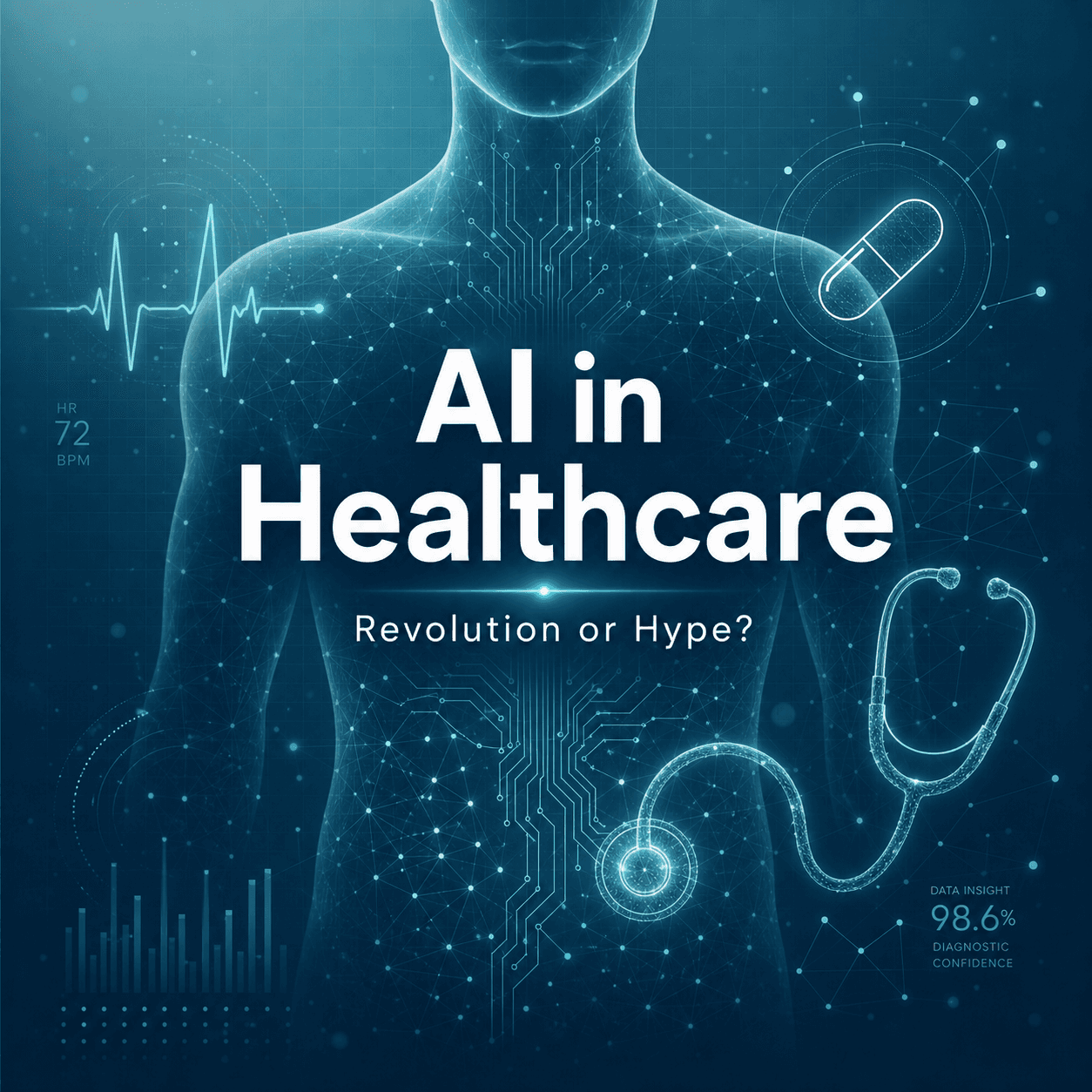
Healthcare is weird.
It’s one of the most advanced industries on earth, full of brilliant people, billion dollar machines, cutting edge drugs, and research that honestly feels like science fiction. And yet, if you’ve ever tried to book a specialist appointment, or had a family member bounce between departments, or sat in an ER at 2 a.m. staring at a vending machine… you know what I mean.
So when people ask, “Can artificial intelligence revolutionize healthcare?” my gut response is: it already is, just not in the clean, movie version of a revolution.
The real question is whether AI can make healthcare meaningfully better for patients and clinicians, at scale, without making things more expensive, more confusing, or more unfair.
Because that’s the thing. Healthcare doesn’t need more shiny tech. It needs fewer mistakes, faster access, clearer decisions, and less burnout. It needs boring wins. The kind you feel when your test results come back on time and actually make sense. When your doctor isn’t staring at a screen the whole visit. When a medication error gets caught before it reaches you.
AI could help with all of that.
Or it could create brand new problems. Also very possible.
Let’s talk through it like a real person, not like a conference keynote.
What “revolutionize” even means in healthcare
People throw around the word “revolution” like it’s an app update.
In healthcare, change is slow for a reason. If you mess up a social media feed, you annoy people. If you mess up a cancer diagnosis, you ruin a life.
So a healthcare revolution is not going to be one single moment where hospitals flip a switch and suddenly everything is perfect. It’s more like… death by a thousand improvements. Or maybe life by a thousand improvements. That sounds nicer.
If AI does revolutionize healthcare, it will probably look like this:
- Doctors get decision support that actually saves them time, not more clicks.
- Patients get earlier detection of disease, more consistent care, fewer delays.
- Hospitals run smoother and waste less money on obvious inefficiencies.
- Medical research speeds up significantly; for instance AI could help speed up drug design for conditions like Parkinson’s ten-fold, drug discovery gets less brute force.
- Admin work shrinks. Or at least stops growing.
But it only counts as a revolution if the improvements are real, measurable, and widespread. Not just a pilot program in a fancy hospital.
Where AI is already making a difference (quietly)
AI in healthcare isn’t new. We’ve had algorithms in radiology and lab systems for years. What’s new is the mix of better machine learning, massive datasets, cheaper compute, and now generative AI that can read and write like a human.
That combo changes what’s possible.
Here are the areas where AI is actually showing up in real workflows.
1. Medical imaging: radiology, pathology, and the “second set of eyes”
This is the most obvious, and honestly one of the most promising use cases.
AI systems can be trained to detect patterns in X-rays, CT scans, MRIs, and digital pathology slides. Sometimes they perform at or near the level of specialists on narrow tasks. Often they are best as an assistant.
Not a replacement. A second set of eyes.
That matters because humans miss things. Not because they’re bad at their job, but because they’re exhausted, distracted, overloaded, and forced to read a ridiculous number of images per day in some settings.
AI can help by:
- Flagging scans that look urgent so they get reviewed faster.
- Highlighting suspicious areas so radiologists don’t have to hunt as much.
- Reducing variation. Two doctors might interpret the same scan differently. AI can add consistency, at least on certain findings.
And no, it’s not perfect. It can miss rare edge cases. It can also hallucinate patterns if trained poorly. But used correctly, in the right clinical setting, it can reduce delays and errors.
Which is kind of the whole point.
2. Early detection and risk prediction
A lot of healthcare is reactive. You feel sick, you go in, you get tested, you get treated. But the expensive and deadly stuff usually builds up quietly for years.
Diabetes. Heart disease. Kidney disease. Certain cancers.
AI can analyze electronic health records, lab values, imaging history, family history, even wearable device data, and identify patients at higher risk earlier than a typical checklist might.
Think of it like this: a clinician might see 20 patients in a morning. AI can “see” 200,000 patient histories and notice subtle patterns that correlate with bad outcomes.
Potential wins here:
- Predicting sepsis earlier in hospitalized patients.
- Flagging risk of hospital readmission.
- Identifying patients likely to deteriorate overnight.
- Detecting atrial fibrillation via wearables.
- Spotting early kidney decline from lab trends.
But here’s the catch. Predicting risk is easy to do badly.
If a model triggers too many false alarms, clinicians start ignoring it. If it triggers too rarely, it misses the point. If it’s trained on biased data, it may under-diagnose risk in certain populations.
So yes, AI can help with early detection. But the design and implementation are everything.
3. Clinical decision support: helping doctors choose better, faster
Doctors make a lot of decisions under uncertainty. Which test to order. Which medication to start. Whether symptoms are a harmless infection or the beginning of something serious.
AI can support that decision-making by:
- Suggesting differential diagnoses based on symptoms and history.
- Recommending guideline-based next steps.
- Checking drug interactions and contraindications.
- Surfacing relevant prior records quickly.
A big one here is simply organizing information.
Electronic health records are often a mess. Notes are long, repetitive, full of copied text, and buried in tabs. Clinicians waste time just trying to reconstruct the patient story.
AI can summarize, extract key facts, and highlight what changed since the last visit. That sounds small, but it’s not. Time is the most scarce resource in medicine.
If AI buys back 5 minutes per patient, that’s huge. That’s fewer rushed conversations. Fewer missed details. More space to think.
Still, the risk is obvious. If clinicians trust AI output too much, or if the AI “sounds confident” while being wrong, that can cause harm. Generative AI especially is good at sounding right.
So decision support has to be transparent, cautious, and designed to keep the human in charge.
4. Administrative burden: the unglamorous battlefield
This is where I think AI could have the biggest impact, fast.
Healthcare is drowning in admin tasks.
- Prior authorizations.
- Coding and billing.
- Documentation.
- Scheduling.
- Referral coordination.
- Insurance forms.
- Claims processing.
Clinicians often spend hours charting. Sometimes more time on documentation than with patients. It’s a major driver of burnout.
AI can help with:
- Drafting clinical notes from transcripts of patient visits.
- Summarizing encounters for discharge instructions.
- Auto-filling repetitive fields.
- Suggesting billing codes.
- Handling routine patient messages.
If this is done right, it doesn’t just save time. It changes the whole feel of a clinic. Less after-hours charting. Fewer “pajama time” notes. More energy left for actual care.
But again, doing it right matters. You don’t want an AI system generating a note that includes something the patient never said, or misrepresents a symptom, or adds a diagnosis incorrectly. That can turn into legal risk, clinical risk, and just messy care.
So the workflow needs guardrails. Review steps. Clear accountability.
5. Personalized medicine and treatment planning
Not everyone responds to treatment the same way. Two patients can have the same diagnosis and wildly different outcomes.
AI can help identify which treatment is likely to work best for which patient by analyzing:
- Genetics and biomarkers.
- Tumor characteristics in oncology.
- Prior treatment response.
- Comorbidities and medication history.
- Lifestyle factors.
This is especially relevant in cancer care, where treatment plans are complex, evolving, and heavily data-driven.
It’s also relevant in mental health medications, autoimmune disease management, and chronic conditions where it often takes months of trial and error.
Personalized medicine is hard. AI won’t magically solve it. But it can help clinicians make better-informed choices.
The bigger opportunity: better access and less inequality (maybe)
One of the most painful parts of healthcare is that access isn’t equal.
Specialists are concentrated in big cities. Rural areas are underserved. Even in cities, wait times can be brutal. And the system is confusing if you don’t know how to navigate it.
AI could improve access in a few ways:
- Virtual triage tools that guide patients to the right level of care.
- Symptom checkers that actually work decently, especially when paired with telehealth.
- AI-assisted ultrasound or imaging interpretation in low-resource settings.
- Remote monitoring for chronic diseases.
But I’m going to say the quiet part out loud.
AI could also widen gaps.
If the best AI tools are expensive, gated behind premium insurance, or only integrated in top hospital systems, then they will improve care for people who already have better care. If training data underrepresents certain groups, performance may be worse for them. If the tools require stable internet, new devices, and good health literacy, they benefit the already-advantaged.
So yes, AI can improve access. But it’s not automatic. It has to be built and deployed with equity in mind, not as an afterthought.
What could go wrong (and why people are right to worry)
You can’t talk about AI in healthcare without talking about risk. Not because AI is evil. Because healthcare is high-stakes, and tech people sometimes underestimate that.
Here are the major concerns.
Bias and unequal performance
AI models learn from historical data. If that data reflects biased care, unequal access, or underdiagnosis in certain groups, the model may reproduce those patterns.
For example, if a dataset includes fewer accurate diagnoses for women’s heart attacks (which historically has been an issue), the model might miss those patterns too.
Bias can show up in subtle ways:
- Risk scores that underestimate severity in certain populations.
- Symptom interpretation that doesn’t generalize across ages or ethnicities.
- Lower accuracy for patients with rare conditions.
The fix is not just “use more data.” It’s careful dataset design, auditing, and ongoing monitoring.
Overreliance and automation bias
If AI says something with confidence, humans tend to believe it. Especially under pressure.
This is dangerous when:
- The model is wrong.
- The model is outside its intended use.
- The patient is an outlier case.
- The clinician is rushed and accepts the suggestion without enough skepticism.
Healthcare AI should be designed to encourage verification, not blind trust. It should show reasoning, cite sources, and make uncertainty visible. And in many cases, it should be conservative.
Privacy and data security
Healthcare data is extremely sensitive. It includes not just diagnoses, but mental health records, genetic info, sexual health history, substance use, and more.
AI systems often need large datasets, and sometimes integration with third parties. That creates risk:
- Data leaks.
- Re-identification of anonymized datasets.
- Unclear consent.
- Secondary uses of data patients never agreed to.
If AI is going to be deeply embedded in healthcare, privacy standards need to be strict and enforced. Not just “we take security seriously” on a webpage.
Liability and accountability
If an AI system contributes to a bad outcome, who is responsible?
- The doctor who used it?
- The hospital that bought it?
- The vendor who built it?
- The data scientists who trained it?
- The regulator who approved it?
This matters because unclear accountability leads to either reckless deployment or paralyzing fear. Neither is good.
Healthcare needs clear rules about AI as a tool. A powerful one, but still a tool. And the responsibility for clinical decisions must be explicit.
The “EHR problem” all over again
Electronic health records were supposed to streamline healthcare. In many ways, they did improve legibility, data sharing, billing, and reporting.
But they also increased clinician workload, created click-heavy workflows, and contributed to burnout.
AI could repeat that pattern if it’s deployed badly.
If AI tools add new alerts, new interfaces, new compliance steps, or new things that have to be reviewed and signed, clinicians will hate it. And then it won’t matter how smart the model is. It will be ignored.
The best healthcare AI will feel invisible. It will reduce friction, not add it.
So… can AI revolutionize healthcare?
Yes. But not in a single sweeping moment.
AI can revolutionize healthcare in the same way antibiotics and imaging did. Not by replacing clinicians, but by changing what is possible, and changing the default standard of care over time.
Here’s the most realistic version of the revolution:
- Fewer diagnostic delays because AI flags risk earlier.
- Fewer preventable errors because systems catch contradictions and interactions.
- Faster imaging workflows and more consistent reads.
- Less admin burden because notes, forms, and coding get automated.
- Better chronic disease management through monitoring and predictive care.
- More scalable expertise, where a rural clinic can tap into AI tools that augment limited staff.
That’s a revolution. It just doesn’t look dramatic.
And I think the biggest truth is this: AI won’t fix healthcare by itself. Healthcare is a human system with incentives, bureaucracy, staffing shortages, and messy politics. If those aren’t addressed, AI becomes another layer on top.
But if AI is used to support clinicians, simplify workflows, and catch what humans miss… it can absolutely shift the baseline.
What needs to happen next (for this to actually work)
If you want AI to improve healthcare in the real world, not just in demos, a few things need to be true.
1. AI must be evaluated like medicine, not like software
Software ships fast. Medicine moves carefully. Healthcare AI should be tested with clinical trials, external validation, and real-world monitoring.
Not just “it performed well on our dataset.”
Different hospitals have different patient populations. Different machines. Different documentation habits. Models drift over time.
Evaluation has to be continuous.
2. Clinicians must be involved from day one
If doctors and nurses aren’t part of building and deploying AI tools, the tools won’t fit reality. Period.
The most common failure mode is a product that looks great to executives and terrible to the people actually doing the work.
3. The incentive structure needs to reward better outcomes, not more volume
This is a big one, and it’s not purely an AI problem.
If healthcare systems make money by doing more procedures and more visits, AI that prevents disease might not be financially attractive. Which is… bleak. But real.
If AI is to fulfill its potential, the business model needs to align with prevention, efficiency, and outcomes.
4. Patients need transparency and control
Patients should know when AI is involved in their care, what data is used, and what the limits are. They should have ways to opt out where appropriate, and strong protections around data use.
Trust is everything in healthcare. Once it’s broken, it’s hard to rebuild.
The bottom line
AI can revolutionize healthcare, but only if we treat it like a clinical tool, not a magic trick.
The best future is not “AI doctors.” It’s better doctors with better systems. It’s nurses who spend more time caring and less time clicking boxes. It’s patients who get earlier answers and clearer guidance. It’s fewer avoidable tragedies caused by missed details and overloaded staff.
Will AI fix everything? No. It will also create new problems, because that’s what technology does.
But if we stay grounded, focus on real outcomes, and keep humans in charge of the decisions that matter…
Yeah. It can be a revolution. Quiet, practical, and honestly long overdue.
FAQs (Frequently Asked Questions)
Can artificial intelligence (AI) truly revolutionize healthcare?
AI is already revolutionizing healthcare, but not in a flashy, overnight way. Instead, it’s driving gradual, meaningful improvements like faster access to care, fewer mistakes, and reduced clinician burnout. The real revolution is about life-changing, measurable benefits at scale without adding cost or complexity.
What does a ‘revolution’ in healthcare look like with AI integration?
A healthcare revolution through AI involves thousands of small improvements such as time-saving decision support for doctors, earlier disease detection for patients, smoother hospital operations with less waste, accelerated medical research (like faster drug design), and shrinking administrative burdens—all leading to better outcomes and efficiency.
Where is AI already making a significant impact in healthcare workflows?
AI is actively used in medical imaging as a ‘second set of eyes’ assisting radiologists and pathologists by flagging urgent scans and highlighting suspicious areas. It’s also advancing early detection and risk prediction by analyzing vast patient data to identify risks sooner, and supporting clinical decision-making by helping doctors choose better tests and treatments faster.
How does AI improve medical imaging accuracy and efficiency?
AI systems trained on X-rays, CT scans, MRIs, and pathology slides can detect patterns comparable to specialists on specific tasks. They reduce human errors caused by fatigue or overload by flagging urgent cases promptly, highlighting suspicious regions to reduce search time, and providing consistent interpretations to minimize variability between doctors.
What are the challenges when using AI for early disease detection and risk prediction?
While AI can analyze extensive health data to predict risks like sepsis or kidney decline earlier than traditional methods, challenges include avoiding too many false alarms that cause alert fatigue, ensuring sufficient sensitivity to catch true risks, and preventing bias from training data that could lead to underdiagnosis in certain populations. Proper design and implementation are critical.
How can AI support clinical decision-making for doctors?
Doctors face numerous complex decisions daily under uncertainty. AI can assist by providing evidence-based recommendations on which tests to order or medications to prescribe. This support aims to make decisions faster and more accurate without adding extra clicks or complexity, ultimately improving patient care while reducing clinician burnout.

