




Sports training used to be pretty simple, at least on the surface.
You showed up. You ran drills. You lifted weights. A coach watched, yelled a few cues, maybe filmed something on a shaky phone if you were lucky. Then you went home and hoped you were improving.
And honestly, that system still works. It created champions for decades.
But it also has a bunch of blind spots.
Because a coach can not see everything. Not in real time. Not across every rep. Not across every athlete. And athletes, even very disciplined ones, are… humans. We forget how something felt. We misjudge effort. We overtrain. We undertrain. We convince ourselves a bad movement is fine because we hit the target anyway.
This is where AI is starting to change the day to day reality of training. Not in a sci fi way. More like, quietly, then all at once.
It is turning training into something more measured, more individualized, more responsive. Sometimes a little annoying too, because now the data calls you out. But overall, it is making athletes better prepared with fewer wasted hours.
Let’s talk about what is actually happening.
The big shift: from “coaching by eye” to “coaching with evidence”
A great coach’s eye is valuable. No argument. The problem is consistency.
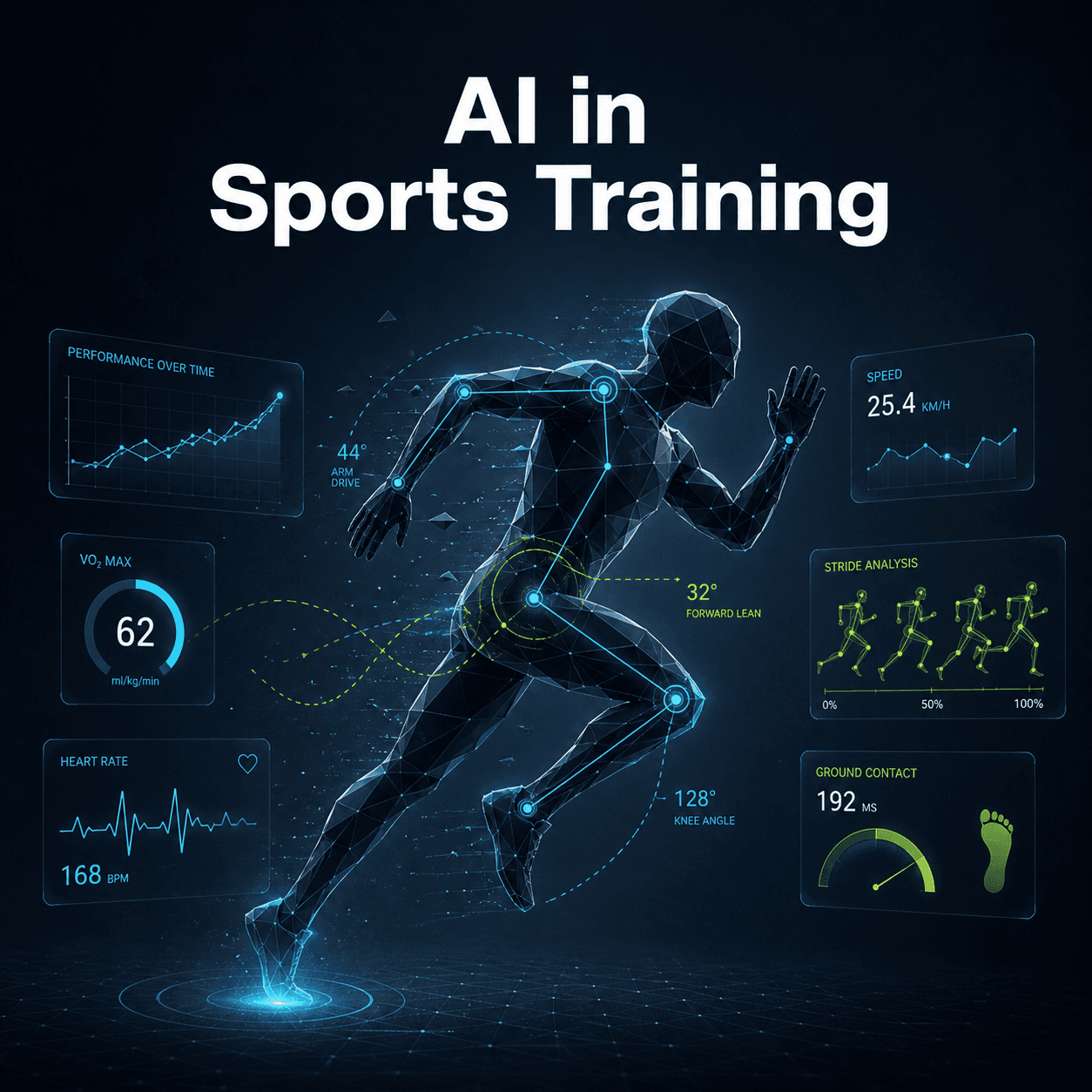
If you run ten sprints, your form on sprint #2 might be clean, and sprint #9 might be falling apart. A coach notices some of it, but not every little change. AI systems, paired with cameras, wearables, force plates, GPS trackers, or smart gym equipment, can capture the whole session and flag patterns humans miss.
Not just “your knee caves in.” More like:
- It happens mostly on reps after a certain fatigue level
- It gets worse on days after heavy lower body work
- It correlates with reduced ankle dorsiflexion and a slower ground contact time
- It predicts you are more likely to feel pain in the next two weeks if you keep pushing volume
That last part is the key. AI is not only describing what happened. It is starting to forecast what might happen.
And once you have that, training becomes less guessy.
Smarter performance analysis (and way less manual video pain)
Video analysis has been around forever. The difference now is automation.
AI computer vision can track joints, posture, angles, speed, and sequencing, without you manually scrubbing footage and drawing lines on the screen like it is a biology lab.
So in sports like baseball, tennis, golf, swimming, track, even weightlifting, you can get feedback fast:
- release angle and spin efficiency
- hip shoulder separation timing
- stride length changes at different intensities
- bar path consistency in Olympic lifts
- stroke rate and symmetry in the pool
This matters because feedback timing matters. If an athlete gets corrected days later, the brain has already reinforced the pattern.
With AI assisted video, you can sometimes correct it in the same session. Not perfectly, but close enough that the athlete can feel the difference and lock it in.
Also, this helps younger athletes who do not have access to elite coaching. A high school sprinter with a phone tripod and the right software can get surprisingly detailed insights.
Not the same as a world class coach, sure. But it is a leap from “I think I look fine.”
Training plans are becoming individualized in a real way
A lot of training programs claim to be personalized. But most personalization is basically:
- age
- bodyweight
- sport
- “beginner, intermediate, advanced”
- maybe injury history if someone remembers to include it
AI can go deeper because it can process a messy pile of inputs and still find useful signals.
Things like:
- sleep quality and consistency
- HRV trends (heart rate variability)
- resting heart rate
- training load from previous sessions
- mood and soreness check ins
- travel schedule and time zone shift
- menstrual cycle factors for some athletes who track it
- nutrition consistency (even rough logging helps)
- performance output (sprint times, jump height, bar velocity, etc.)
Then instead of following a rigid plan, the training adjusts. Maybe the athlete still does the session, but the intensity or volume shifts. Or the warmup becomes longer because readiness looks low. Or the system suggests a technique focused day because force output is trending down.
The point is not to “let the algorithm decide everything.” The point is to stop pretending every athlete responds the same way to the same stimulus.
Because they do not.
AI is changing strength training with velocity and form tracking
In the gym, AI shows up in a few ways.
One is velocity based training, where bar speed is used to manage intensity and fatigue. Traditionally, this required dedicated hardware. Now, AI apps and smart devices can estimate velocity from video or sensors and give immediate feedback like:
- your speed is down 15 percent from your top set
- stop the set here if the goal is power
- reduce load today, your output says you are not recovered
Another is movement quality tracking. Computer vision systems can evaluate squat depth consistency, knee tracking, torso angle, and rep tempo. Not perfectly. Still, it is improving fast.
This is especially useful for team settings. A strength coach overseeing 30 athletes can not watch every rep. AI can flag the 3 athletes whose technique degraded the most during the session, so the coach spends attention where it matters.
Also, AI can help reduce ego lifting, which is a polite way to say… dumb lifting. When the system shows you that your “PR” was actually half reps with ugly compensations, it forces honesty.
Not always fun. Useful though.
Injury risk: AI is not a crystal ball, but it can catch bad trends early
This topic gets overhyped. You will see headlines like “AI predicts injuries before they happen.” That is not how it works in real life.
Injuries are messy. They involve tissue capacity, training load, technique, recovery, stress, previous injury history, randomness, and sometimes plain bad luck.
But AI can still help, because a lot of injuries are preceded by warning signs:
- asymmetries increasing over time
- reduced range of motion
- changes in landing mechanics
- spikes in workload
- fatigue indicators trending worse
- compensations showing up on one side
AI systems can combine these indicators and say, basically, “Hey, this athlete is drifting into a danger zone.”
That does not mean an injury is guaranteed. It means you should pay attention.
In practice, this can lead to small adjustments that prevent bigger problems:
- swap a max effort sprint day for technical acceleration work
- reduce plyometric volume
- add soft tissue work, mobility, or eccentric strength work
- change sleep and travel strategies for a heavy competition block
- address a movement limitation before it becomes pain
So no, AI does not magically prevent injuries. But it can help teams be proactive rather than reactive.
And in pro sports, that is a huge deal. One injured starter can swing a season.
Better decision making during practice and competition
AI is moving closer to real time coaching, especially in sports with tracking infrastructure.
Think GPS and accelerometers in soccer, rugby, American football, hockey. Or shot tracking in basketball. Or motion capture in baseball training facilities.
Coaches can see:
- who is accumulating the most high speed running volume
- who is decelerating more than usual (a fatigue sign)
- who is cutting at sharper angles and might need load management
- whether practice intensity matches the planned training objective
- whether a player is “quietly” doing too much work while others are coasting
This changes how sessions are managed.
Instead of guessing if practice was hard enough, the staff can measure it. And they can adjust the next day accordingly.
At the elite level, this is turning into a kind of training economy. You are spending fatigue like it is money, trying to get the best performance return without going broke.
Skill acquisition is getting more efficient, especially with feedback loops
One underrated impact of AI is how it can tighten feedback loops for skill learning.
Learning a skill is not just repetition. It is repetition with correction. You need to know what you did, what to change, and whether you improved.
AI can provide that loop faster.
Examples:
- A basketball shooter gets immediate feedback on arc, release timing, and left right deviation.
- A golfer gets data on club path, face angle, attack angle, and strike location.
- A pitcher sees how subtle grip changes affect spin axis and movement.
- A sprinter sees how shin angle and ground contact time shift across attempts.
This speeds up learning because it reduces the “mystery” between cause and effect. Instead of guessing what worked, the athlete can connect the feeling with the result.
It is not perfect, because sports skills are not only mechanics. They are perception, decision making, timing, pressure.
Still, when you remove confusion from the mechanical side, you free attention for the more complex stuff.
AI coaching assistants are becoming a thing, and it is weird but helpful
This part is newer, but it is happening.
AI assistants can act like a training operations helper. They can:
- summarize training weeks
- flag load spikes
- create simple practice plans based on constraints
- draft individualized recovery suggestions
- answer “what changed?” when performance dips
- generate athlete friendly explanations from complex data
In a team environment, staff spend a lot of time doing admin, reporting, and communication. AI can reduce that overhead.
For individual athletes, especially those without full time coaching, an assistant can keep them organized and consistent.
But. Important.
An AI assistant does not know your body. It knows your data. Those are not the same. If the data is incomplete or wrong, the advice will be off. So the best use is as a second brain, not the head coach.
What this means for everyday athletes, not just pros
It is easy to think AI in sports is only for billion dollar teams with fancy labs.
But a lot of it is trickling down.
You can already get:
- running form analysis from phone video
- smartwatches that estimate training load and recovery
- cycling platforms that predict fatigue and optimize workouts
- gym apps that track reps and technique with computer vision
- sleep trackers that tie recovery to training recommendations
Some of these are gimmicky, yes. Some are surprisingly solid.
The real value for normal athletes is consistency and course correction.
If you are training for a marathon, AI based tools can help you avoid ramping mileage too aggressively. If you are lifting, they can help you manage intensity so you do not grind yourself into dust. If you are playing a sport recreationally, they can help you warm up smarter and notice patterns that lead to pain.
Not glamorous. Just useful.
The limitations, because there are plenty
AI is powerful, but sports training is a messy environment. So let’s be honest about what can go wrong.
Data quality can be garbage
If the wearable is loose, the GPS signal is off, the camera angle is bad, or the athlete forgets to log key info, the AI output can be misleading.
Bad input, confident output. That is the danger.
AI can overemphasize what is measurable
Not everything important is easy to measure. Leadership, composure, tactical intelligence, resilience, creativity. These matter a lot, and AI tends to focus on the mechanical and physiological side because that is what sensors capture. This overemphasis on measurable aspects can lead to overlooking critical qualitative traits.
Athletes can become overly dependent
If someone needs a readiness score to tell them how they feel, that is a problem. Data should calibrate intuition, not replace it.
Privacy and ownership issues are real
Athlete data is sensitive. Especially health-related metrics. Teams and platforms need clear policies about who owns the data, who can access it, and how it can be used.
This is going to be a bigger conversation over the next few years.
So where is this going next?
A few trends feel pretty likely.
- More training environments will use simple camera-based systems as standard, like having mirrors in the gym.
- Real-time feedback will get more common, not just post-session reports.
- AI models will get better at context, meaning they will understand not just the movement but also the training phase, the athlete’s history, and the goal of the session.
- We will see more “closed loop” training, where measurement, analysis, and program adjustment happen continuously.
And maybe the biggest change.
Coaching will shift toward decision making, communication, and psychology—the human stuff. Because if AI handles more measurement, the best coaches will differentiate by how well they guide people rather than how well they track spreadsheets.
Final thoughts
AI is not replacing coaches. It is replacing guesswork.
It is giving athletes clearer feedback, more personalized plans, earlier warnings when something is off, and a better way to connect effort with results. Not always perfectly. Sometimes it gets things wrong. Sometimes it creates noise.
But overall, training is becoming less about grinding blindly and more about adapting intelligently.
And honestly, that is what most athletes want anyway.
Get better. Stay healthy. Waste less time. Keep the joy in it.
AI, used well, can help with all of that.
FAQs (Frequently Asked Questions)
How is AI transforming traditional sports training methods?
AI is enhancing sports training by providing more measured, individualized, and responsive coaching. Unlike traditional methods where coaches rely on observation and memory, AI systems use data from cameras, wearables, and smart equipment to capture every rep and session detail. This allows for precise feedback, pattern recognition, and forecasting potential injury risks, making training more effective and less guesswork-driven.
What advantages does AI offer over human coaches in performance analysis?
While a great coach’s eye is valuable, AI offers consistency and depth by tracking joints, posture, angles, speed, and sequencing automatically through computer vision. It eliminates manual video review pain by delivering fast feedback on metrics like release angle, stride length, or bar path consistency. Timely feedback helps athletes correct form during sessions rather than days later, accelerating skill acquisition.
In what ways are training plans becoming truly personalized with AI?
AI personalizes training by analyzing a broad range of inputs beyond basic factors like age or sport level. It incorporates sleep quality, heart rate variability (HRV), mood, soreness check-ins, travel schedules, menstrual cycles, nutrition logs, and performance outputs to dynamically adjust intensity, volume, warm-ups, or focus areas. This approach recognizes that each athlete responds differently to stimuli rather than following rigid one-size-fits-all programs.
How does AI assist in strength training through velocity and form tracking?
AI supports strength training via velocity-based training (VBT) by estimating bar speed through video or sensors to manage intensity and fatigue with immediate feedback. Additionally, computer vision systems evaluate movement quality such as squat depth consistency and knee tracking. This helps coaches monitor multiple athletes efficiently by flagging technique degradation and reducing risky ‘ego lifting’ behaviors.
Can AI predict injury risks during sports training sessions?
Yes. By analyzing patterns like when fatigue affects form (e.g., knee caving in after certain reps), correlations with reduced ankle mobility or slower ground contact times, AI can forecast the likelihood of pain or injury if current training volumes continue. This predictive capability enables proactive adjustments to prevent overtraining and reduce injury risk.
Is AI-assisted video analysis accessible to amateur or younger athletes?
Absolutely. With advancements in AI computer vision and affordable technology like smartphone tripods and apps, even high school athletes can receive detailed insights into their technique across various sports such as sprinting or weightlifting. While not a replacement for world-class coaching, it significantly elevates feedback quality beyond subjective self-assessment.