




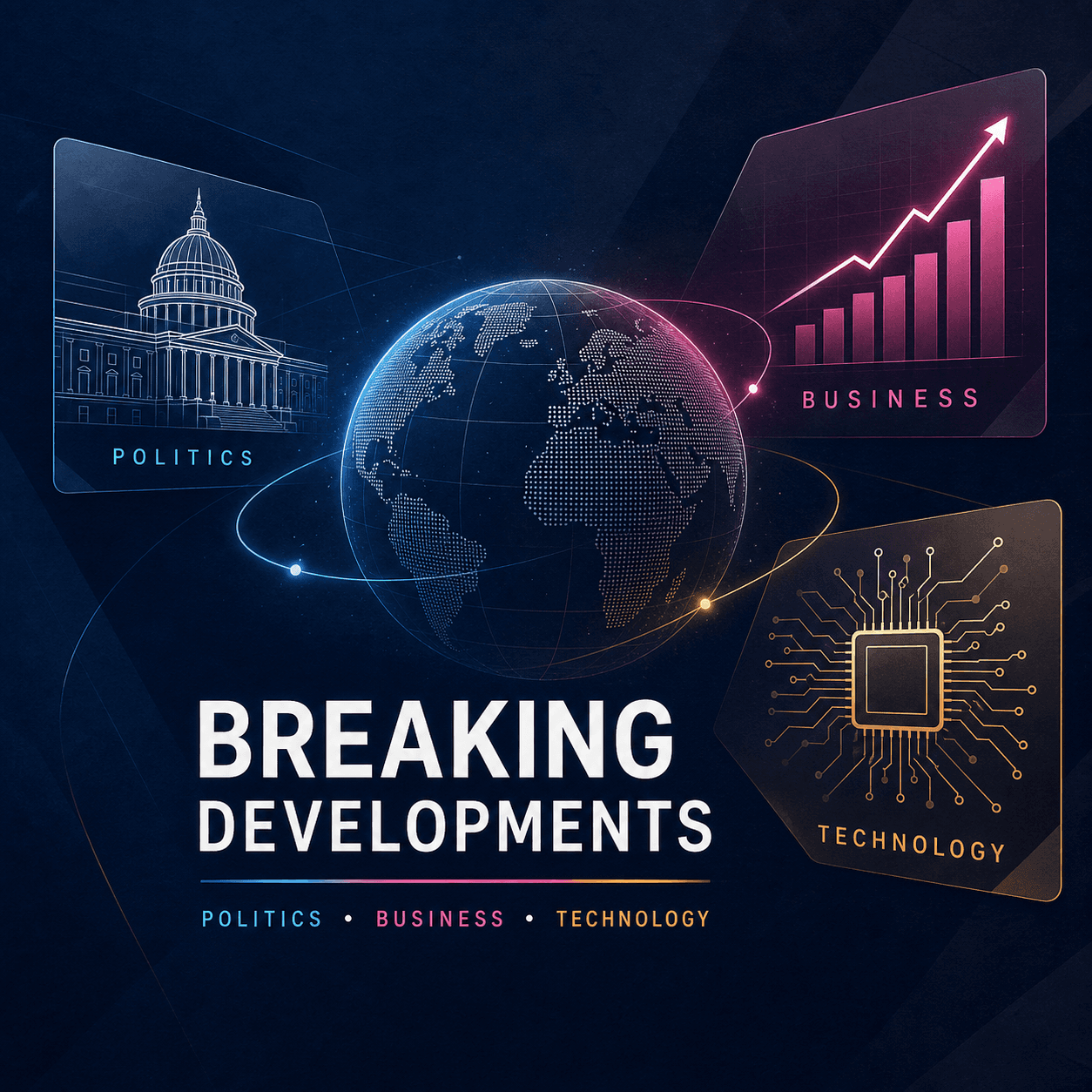
Some weeks feel like nothing happens, and then you blink and everything moves at once.
Politics is getting rewired in real time by courts, elections, and the simple reality that most governments are running on tight budgets and even tighter trust. Business is doing that familiar thing where executives say one thing on stage, then do another thing in the org chart. Technology is accelerating, but it’s not this clean sci fi arc. It’s messy, it’s regulatory, it’s “wait, who owns the data” and “why did the model do that” and “why is my company paying for three AI tools that all do the same thing.”
So this is a snapshot of the most important developments. Not every headline. The ones that actually change incentives.
Politics: elections, legitimacy, and the slow grind of institutions
A lot of political “breaking news” is basically theater. A hot take, a clip, a statement crafted to be screenshotted.
But underneath that, there are a few structural shifts worth paying attention to.
1) The election year stress test is already here
Even before ballots are counted, election years tend to pressure test the whole system. Courts get busier. Agencies get more cautious. Parties become more rigid, because everyone is thinking about turnout, not governance.
You see it in the way candidates talk. Less policy detail, more identity signaling. Less “here’s how we pay for it,” more “they are coming for you.” And, honestly, it works. It works because people are exhausted and overstimulated and can’t be asked to read a 40 page plan.
The thing to watch is not the daily polling swing. It’s what happens to confidence in the process. The more the process itself becomes the story, the harder it is for any winner to govern the day after.
Also, local elections and down ballot races matter more than people admit. That’s where rules get set. That’s where district maps get drawn. That’s where the boring stuff happens, and the boring stuff is the power.
2) Courts and regulators are effectively writing policy
In a lot of countries, legislatures are stuck. Gridlock, coalitions, internal faction fights, you name it. That pushes policy making into courts and agencies.
What that means in practice.
- Big social issues get decided via judicial rulings instead of legislative compromise.
- Business policy gets shaped by enforcement actions, not new laws.
- The public learns about rules after they are already being applied.
This creates a strange political cycle. Politicians campaign on sweeping promises, but the actual changes come through incremental rulings and regulatory updates. So voters feel like “nothing changes,” while institutions quietly reshape the playing field.
If you’re trying to understand what’s next, you watch the legal calendars and agency agendas, not just speeches.
3) Foreign policy is colliding with domestic economics
This is the one that keeps showing up everywhere. Trade, energy, defense, supply chains, immigration. These are no longer separate buckets.
Governments want to be tougher abroad while keeping prices stable at home. That is an awkward combo. If you restrict a supplier, prices can rise. If you sanction a sector, someone’s domestic industry gets hit. If you subsidize local production, another country calls it unfair and retaliates.
This is where politics meets business in a very direct way. You can’t just say “national security” and expect investors and consumers to ignore the cost.
The practical takeaway is that geopolitics is now a line item. Companies are treating it like a risk category alongside interest rates and labor costs. That is new-ish. Or maybe it’s old, but it’s back.
Business: the economy is not one economy, and companies are acting like it
The most confusing thing about business news right now is that you can find a statistic that supports almost any narrative.
- “Consumers are resilient.”
- “Consumers are tapped out.”
- “Hiring is strong.”
- “Nobody is hiring.”
- “AI will replace jobs.”
- “AI isn’t delivering ROI.”
All of those can be true, depending on sector, income bracket, and geography.
So instead of trying to pick one storyline, it helps to look at what companies are actually doing. Budget decisions. Headcount decisions. Capital spending. That’s where the truth leaks out.
1) The quiet shift from growth to efficiency is still happening
Yes, there are exceptions. Some companies are growing fast. Some sectors are genuinely booming.
But broadly, the executive mood has been: do more with less, and prove it.
You see it in:
- flatter org charts
- consolidation of tools and vendors
- fewer experimental projects
- pressure on middle management to justify layers
The funny part is that a lot of businesses say they’re “investing in innovation” while cutting the exact teams that used to do innovation. What they mean is: we are investing, but only in things that look like they’ll pay back quickly.
This is one reason AI is being pushed so hard inside companies. Not always because it’s magical. Sometimes because it’s a story that makes cost cutting sound like progress.
2) Small businesses are feeling a different reality than large ones
Big companies can refinance, negotiate, absorb shocks, and move costs around. Small businesses often cannot. They’re more exposed to rent increases, input costs, and changing consumer demand.
What’s interesting is how this affects local politics too. When small businesses struggle, community frustration rises. People feel it in their daily life. Storefronts change. Hours get cut. Service quality drops. That translates into broader resentment, even if the macro numbers look fine.
Also, more small businesses are adopting “enterprise style” software now. Not because they want to. Because the market nudges them there. Booking systems, payment platforms, ad networks, AI customer support, online ordering. The digital toll booths keep multiplying.
3) The labor market is splitting into two experiences
If you’re in a high demand technical role, or a specialized healthcare role, or a skilled trade in the right place, the market can still feel tight. Negotiation power, options, recruiters.
If you’re in a broad white collar category where companies think AI can help reduce hiring, the mood is different. Fewer open roles, longer processes, more “we paused the position” emails, and a lot of contract work instead of permanent roles.
We’re also seeing a weird phenomenon where companies want “AI experience” for roles that barely existed two years ago. Prompting, model evaluation, AI product ops, governance. Some of this is legit. Some of it is buzzword inflation.
But the direction is clear. AI literacy is becoming baseline. Not “everyone become a machine learning engineer.” More like, can you use these tools responsibly and get real work done without making a mess.
Technology: AI is moving from novelty to infrastructure, and that changes the fights
It’s easy to get stuck in the AI hype loop. New model release, new benchmark, new demo that looks impressive, then everyone argues about whether it’s real intelligence.
Meanwhile, the actual shift is more mundane and more consequential. AI is becoming infrastructure. It’s being baked into search, office tools, customer support, cybersecurity, coding, design, and analytics.
Infrastructure means dependence. Dependence means power. And then the fights start.
1) The AI platform war is about distribution, not just model quality
Model quality matters, sure. But distribution matters more.
The winners will be the systems that are already where work happens:
- productivity suites
- browsers and search
- cloud platforms
- customer service stacks
- developer tools
If a model is slightly worse but it’s embedded into the workflow, it can win. Users pick convenience. Businesses pick integration. Procurement picks a vendor they already pay.
This is why you keep seeing partnerships, default placements, “AI assistant” buttons everywhere. Nobody wants to be the layer that gets swapped out.
2) The compute and energy constraints are real, and they are shaping strategy
Training and running large models takes a lot of compute. Compute takes chips, data centers, and electricity. Electricity takes grid capacity, permits, and time.
So the AI race is also a construction race. Who can build, power, and cool enough infrastructure fast enough.
This is pushing a few noticeable trends:
- more interest in smaller, efficient models
- more on device AI for privacy and cost
- more specialized models tuned to specific tasks
- aggressive investment in data center expansion and energy deals
People talk about AI like it’s purely software. It’s not. It’s physical. It’s industrial. And that means it runs into the real world, where projects get delayed and locals complain and regulators ask questions and transformers are backordered.
3) Regulation is no longer “coming someday,” it’s becoming operational
A few years ago, tech regulation was mostly a debate. Now it’s implementation.
Companies are building internal governance: model audits, data lineage, bias testing, security reviews, documentation, human oversight workflows. Sometimes sincerely. Sometimes because legal told them to.
The challenge is that regulation moves slower than technology. That’s not a hot take, it’s just true. So regulators aim for principles. Companies want checklists. And in the gap between those, you get confusion.
There’s also the cross border problem. A tool built in one jurisdiction gets used in another, with different standards. Multinational companies end up building to the strictest regime or they fragment products by region.
Either way, compliance is becoming a feature. Not a nice to have. A feature.
4) Deepfakes and synthetic media are shifting from novelty to governance problem
This used to be a “wow” category. Now it’s a risk category.
The problem is not that every video is fake. The problem is that people can plausibly claim anything is fake. That is a different kind of destabilization. It doesn’t require perfect deepfakes. It just requires enough doubt.
Governments are responding with:
- watermarking requirements or proposals
- election integrity rules
- platform disclosure policies
- identity verification for certain types of content
Platforms are stuck in a bad spot. They’re expected to police content at scale, in real time, across languages, with imperfect tools, while also protecting speech. They will fail at this in some way. Not because they’re evil. Because it’s almost impossible.
For businesses, the risk is reputational and operational. A fake clip can move a stock. A fake memo can trigger a crisis. A fake customer support thread can become a viral complaint.
Crisis comms teams are adapting. Verification workflows matter more now. And yes, boring things like media provenance and internal access control are suddenly strategic.
Where politics, business, and tech collide most sharply
The biggest story isn’t any single headline. It’s the collision points.
1) National security meets industrial policy meets corporate strategy
Chip restrictions, telecom rules, foreign investment reviews, defense tech funding. This is shaping where factories get built and who gets access to key components.
Companies are being asked, sometimes quietly, to align with national goals. And governments are learning they can’t just regulate. They have to subsidize and coordinate, or they lose capacity.
This is why you see so many announcements about local manufacturing, supply chain resilience, “strategic industries.” Some of it is real. Some of it is branding. But the direction is real.
2) Data is the new bargaining chip, and everyone wants a piece
AI runs on data. Governments want control over citizen data. Companies want data for personalization and model training. Consumers want privacy but also convenience. Courts are trying to interpret old laws for new realities.
The practical outcome is more friction:
- stricter data sharing agreements
- more consent screens that nobody reads
- more lawsuits about scraping and copyright
- more technical measures to block automated collection
If you are building in tech right now, data rights is not an “eventually” issue. It’s a day one issue.
3) Trust is becoming a competitive advantage, but it’s hard to manufacture
People are skeptical. About politicians, about corporations, about media, about AI.
Some companies will respond with marketing. That won’t work for long.
The more durable approach is operational trust. Clear policies. Transparent product behavior. Real customer support. A willingness to say “we messed up” without the legalistic non apology.
In politics, trust looks like competent administration and predictable rules. In business, it looks like not surprising customers. In technology, it looks like systems that are safe, explainable enough, and not constantly changing the terms.
Not glamorous. But it’s where the long term winners tend to land.
What to watch next, in plain terms
If you want a short list of signals that matter more than the daily noise, here’s mine.
In politics
- Legal and electoral process disputes, and how quickly institutions resolve them.
- Coalition stability and budget votes. The boring fiscal stuff that decides what actually happens.
- Any major shift in foreign policy that affects energy or trade, because it hits wallets fast.
In business
- Corporate spending on AI moving from pilots to renewals. Renewals mean it’s working, or at least politically impossible to stop.
- Hiring patterns. Not headlines about layoffs, but the slow reopening or freezing of roles.
- Credit conditions for smaller firms. If small businesses can’t borrow, everything downstream tightens.
In technology
- Whether AI features get used daily, not just demoed. Usage is the moat.
- Compute constraints: chip supply, data center buildouts, energy deals.
- The next wave of regulation that becomes enforceable, with penalties, not just guidelines.
The bottom line
Politics is wrestling with legitimacy and capacity. Business is still trying to grow while being forced to prove efficiency. Technology is becoming infrastructure, which means it’s no longer just a product conversation. It’s power, dependencies, rules, and risk.
And yeah, it can feel like too much at once.
But if you look at incentives instead of slogans, it gets clearer. Governments want stability and control. Companies want predictable costs and defensible advantage. Tech platforms want distribution and lock in. Regular people want things to work, to be fair, to not get more expensive, and to not feel like they’re being lied to.
That gap between what people want and what systems reward. That’s where the next breaking developments will come from.
FAQs (Frequently Asked Questions)
How do election years impact political stability and governance?
Election years act as stress tests for political systems, increasing court activity, making agencies more cautious, and causing parties to focus more on identity signaling rather than detailed policy. This shift can undermine confidence in the electoral process and complicate governance after elections.
In what ways are courts and regulators shaping policy today?
With legislative gridlock common, courts and regulatory agencies have become primary policy makers. They decide major social issues through judicial rulings and shape business policies via enforcement actions, often implementing changes incrementally that voters notice only after they take effect.
How is foreign policy influencing domestic economic decisions?
Foreign policy now intersects heavily with domestic economics through trade restrictions, sanctions, subsidies, and supply chain management. Governments aim to balance national security with price stability at home, leading companies to treat geopolitics as a critical risk factor alongside traditional economic concerns.
Why do business narratives about the economy seem contradictory right now?
Economic indicators vary widely across sectors, income groups, and regions. For example, some data shows resilient consumers while others indicate financial strain. Understanding the real picture requires looking at company actions like budget cuts, hiring trends, and capital spending rather than isolated statistics.
What is driving the shift from growth to efficiency in businesses?
Many companies are prioritizing doing more with less by flattening organizational structures, consolidating tools, cutting experimental projects, and pressuring middle management for justification. Investment focuses on initiatives promising quick returns, with AI adoption often framed as cost-cutting progress rather than pure innovation.
How are small businesses experiencing economic challenges differently from large corporations?
Small businesses face greater exposure to rent hikes, rising input costs, and fluctuating consumer demand compared to large firms that can refinance debt or absorb shocks. This disparity not only affects their survival but also influences local politics due to their significant role in communities.