




If you run a business, you already know the feeling.
You are trying to ship product, keep customers happy, deal with hiring, deal with whatever the economy is doing this week. And then somewhere in the middle of all that, you get a security alert. Or an invoice email that looks slightly off. Or a “quick” Slack message from the CEO asking for gift cards. Again.
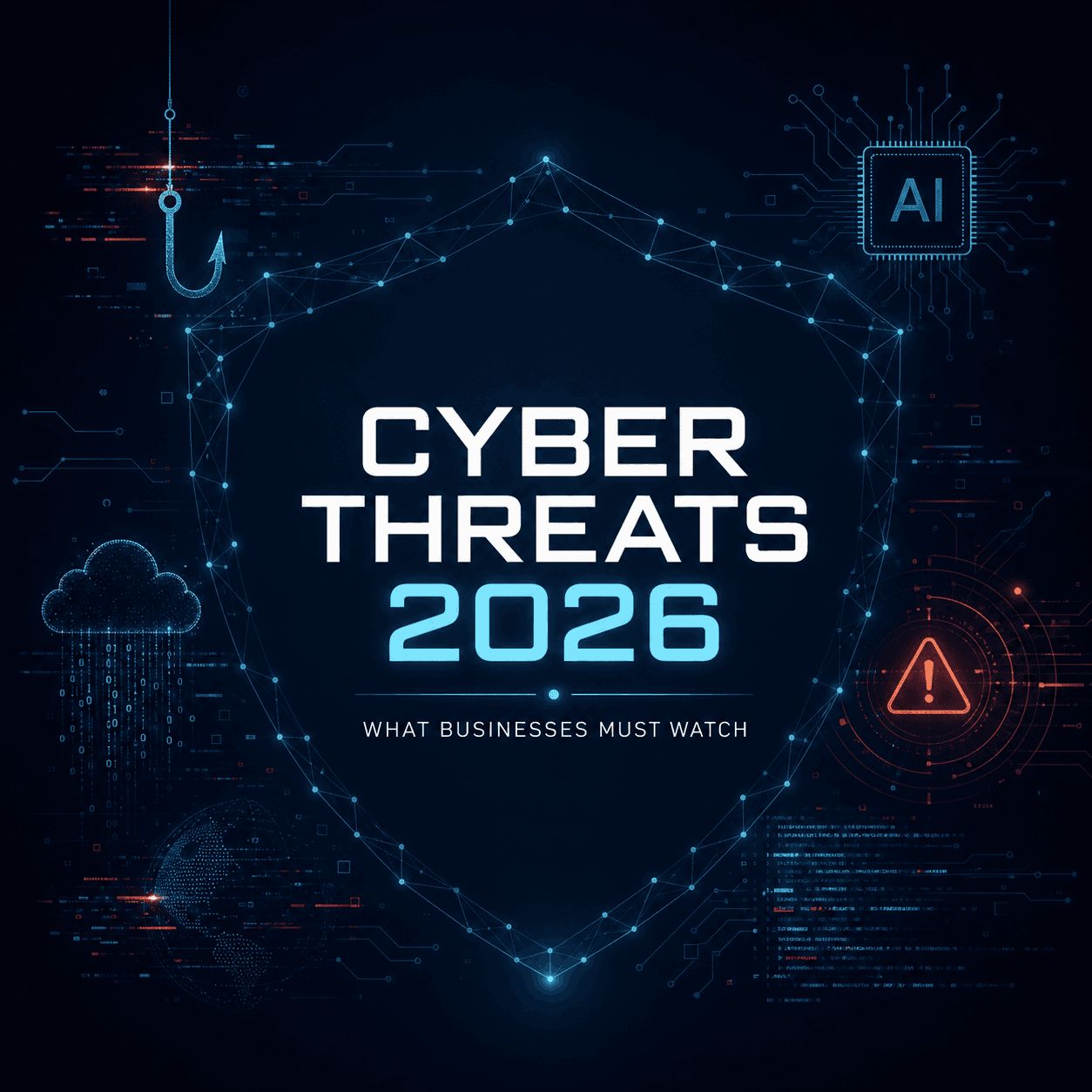
Cybersecurity in 2026 is not going to be about one big Hollywood style hack. It’s going to be lots of smaller, faster, more believable attacks. A bunch of them won’t even look like security incidents at first. They will look like normal work.
And that’s the problem.
This is a practical rundown of the threats businesses need to actually watch, not just in theory, but in the day to day. The stuff that is already trending upward, and the stuff that gets worse when AI, cloud complexity, vendors, and humans all collide.
1. AI powered phishing that actually sounds like your coworker
Phishing used to be kind of funny. Terrible grammar, weird urgency, the classic “kindly do the needful” energy.
Now it’s clean. It is written in the same tone your finance team uses. It references real projects. It can mimic your internal phrasing, like the way your org labels purchase requests or how you name shared drives. And if an attacker has access to one compromised inbox, they can watch threads and respond at exactly the right moment.
In 2026, expect more of this:
- Vendor invoice fraud that matches real invoice formats and timing.
- HR themed lures, especially around benefits, tax documents, policy updates, “required training”.
- Collaboration tool lures. Fake Microsoft 365 share links, fake DocuSign, fake Slack “file previews”.
- Spearphishing that starts casual. No urgency at first. Just a normal message, a normal question. Then the ask comes later.
The tricky part is that AI helps attackers run volume without losing quality. So they can go after mid sized companies the same way they used to only go after huge ones.
What to do about it, realistically:
- Treat email authentication as table stakes. SPF, DKIM, DMARC with enforcement, not just monitoring forever.
- Add payment change controls. Any bank detail change should require a second channel verification.
- Train people on the new signals. Not “look for typos”. More like, “verify unusual requests even if the tone is perfect.”
- Make reporting easy. A one click “report phishing” button that actually goes somewhere and gets a response.
2. Deepfake voice and video scams moving into normal business workflows
This is the one everyone talks about, but it’s worth taking seriously because the use cases are getting painfully practical.
A deepfake doesn’t need to be perfect. It just needs to create enough social pressure for someone to act. “I’m in a meeting, I can’t talk long, we need this wire today.” That’s it. That’s the whole game.
By 2026, deepfake fraud will show up more in:
- Finance approvals. Short voice calls, WhatsApp voice notes, Zoom pop ins.
- Sales and vendor relationships. Someone posing as a partner, nudging contract changes.
- Recruiting. Fake candidates, fake background check portals, fake onboarding steps designed to steal documents and credentials.
The uncomfortable truth: people trust audio and video more than text. Even if we all know deepfakes exist, the instinct is still, “I heard them.”
What helps:
- Put a hard rule in place that money movement never relies on voice or video alone.
- Create internal “challenge” practices. Simple, human things. A known phrase. A callback to a known number. A quick question only the real person would know, and not something guessable from LinkedIn.
- Lock down executive public exposure where possible. The more public audio there is, the easier it is to clone. You cannot erase it, but you can be intentional.
3. Ransomware shifting to data theft, extortion, and “quiet” disruption
Ransomware is not going away. But the pattern keeps evolving.
In the past, it was “encrypt everything, demand money.” Now it’s often:
- Steal data first.
- Encrypt or disrupt second, sometimes lightly.
- Extort with proof. Customer data, HR files, contracts, internal chat logs.
- Add pressure with regulatory threats and reputational threats.
And in 2026, expect more “quiet ransomware” style incidents where attackers don’t bother encrypting every endpoint. They might just:
- Kill backups.
- Break identity systems.
- Lock you out of key SaaS tools.
- Corrupt data slowly so you cannot trust it.
That kind of attack can be harder to detect early, because it looks like normal operational chaos. And many companies, honestly, already have plenty of operational chaos.
What helps:
- Immutable backups and tested restores. Not “we back up”, but “we can restore in hours and we have proven it recently.”
- Separate backup credentials from normal admin credentials.
- EDR plus good logging, but also the human process of reviewing. Alerts nobody looks at are not controls.
- A practiced incident response plan that includes legal, PR, and customer comms. Because extortion is a communications crisis too.
4. SaaS identity attacks. Token theft, session hijacking, and MFA bypass
This is a big one, and it hits companies that think they are “safe” because they are cloud first.
Attackers increasingly go after identities, not devices.
If they can steal a session token or hijack an authenticated browser session, they might not care about your password. They might not even care about your MFA, depending on how they got in.
This shows up as:
- “Impossible travel” logins that look like a user, because it is the user session.
- OAuth app abuse. A user clicks “Accept” on a seemingly harmless app, and now the attacker has access to email, files, contacts.
- MFA fatigue attacks. Bombarding push prompts until someone hits accept.
- SIM swap or phone number takeover to intercept codes, still happening, still effective in the right environment.
The real risk is that once inside Microsoft 365 or Google Workspace, attackers can live off the land. They can search mailboxes for invoices, password reset links, customer lists, internal documentation. It’s like getting a map to your whole business.
What helps:
- Phishing resistant MFA where possible. FIDO2 security keys, passkeys, or equivalent.
- Conditional access policies. Block risky locations, risky devices, impossible travel, legacy auth.
- Limit OAuth app consent. Require admin approval for third party apps, especially anything requesting mail or file scopes.
- Shorten session lifetimes for high risk roles and enforce device compliance.
5. Supply chain attacks that hit you through vendors you barely remember hiring
Most businesses are a web of vendors now. Payroll, CRM, marketing automation, analytics scripts, chat widgets, IT support, outsourced dev, managed SOC, you name it.
Attackers love this because you can have great security internally, then get popped through:
- A compromised MSP account.
- A third party integration with too many permissions.
- A software update that gets poisoned.
- A contractor’s laptop that has your VPN config saved.
By 2026, supply chain attacks will be less “one big SolarWinds style moment” and more frequent, smaller, targeted breaches that slip through because nobody is watching the vendor side closely.
What helps:
- Vendor inventory. Not perfect, just honest. What tools touch customer data. What tools touch money. What tools touch credentials.
- Security requirements in contracts for critical vendors. Breach notification timelines, MFA requirements, audit rights where feasible.
- Least privilege for integrations. Do not give “full access” because it is easier. “Easier” is how you end up rebuilding everything later.
- Offboarding discipline. Vendors and contractors should lose access the day they are done. Not “eventually”.
6. API attacks and business logic abuse, not just basic vulnerabilities
A lot of companies have gotten better at basic web security. WAFs, scanners, bug bounties, SAST tools. Good.
But API abuse keeps growing because APIs are how modern apps actually work. And attackers are not always trying to do fancy injection. Sometimes they are just doing the obvious thing at scale.
Like:
- Enumerating customer IDs.
- Abusing password reset endpoints.
- Bypassing rate limits.
- Exploiting weak authorization checks. The classic “I changed the number in the URL and got someone else’s data.”
Business logic flaws are especially painful because they are “valid” requests. They don’t look like attacks in logs, at least not at first.
What helps:
- Strong authz checks everywhere. Not just “is the user logged in”, but “is this user allowed to access this specific object”.
- Rate limiting and anomaly detection tuned to real usage.
- API gateway policies and consistent schema validation.
- Logging that makes investigations possible. If you cannot answer “what data did this token access”, you are flying blind.
7. Cloud misconfigurations, still. But now with more moving parts and more automation
People love to say misconfiguration is the #1 cloud risk, and it’s true, but it’s also a bit lazy. The more interesting part is why it keeps happening.
In 2026, cloud environments are more complex because:
- Teams spin up resources fast.
- Infrastructure is code, which is great, until the code is wrong.
- Permissions sprawl across accounts, subscriptions, projects.
- Temporary exceptions become permanent.
So you end up with:
- Public storage buckets.
- Over permissive IAM roles.
- Exposed admin panels.
- Secrets in environment variables, logs, CI pipelines.
Automation makes this worse and better. Worse because mistakes replicate quickly. Better because you can enforce policy, if you actually do it.
What helps:
- Baseline cloud security posture management. At minimum, alerts on public exposure, overly broad roles, missing logging.
- Treat IAM as a product. Review it, prune it, assign owners.
- Secrets management, not “just put it in the CI variables and hope”.
- Separate environments. Dev should not casually connect to prod data.
8. Insider risk, not always malicious. Often just messy.
Insider threat sounds dramatic. In reality, a lot of insider risk is:
- A stressed employee sending a file to their personal email to work at home.
- Someone pasting sensitive data into an AI tool to summarize it.
- A contractor downloading more than they need because it is faster.
- A departing employee who still has access for two weeks because offboarding is slow.
And yes, sometimes it is malicious. But you cannot build a program only around “bad people”. You build it around normal behavior that becomes risky at scale.
What helps:
- Clear data handling rules that people can follow.
- DLP in the places that matter most. Email, cloud drives, endpoints for sensitive groups.
- Offboarding automation tied to HR events.
- Monitoring for unusual downloads, mass deletes, permission changes. Then a human review, not instant punishment.
9. AI and LLM data leakage. Prompt injection and accidental exposure
This is going to be one of the most misunderstood risks of 2026.
Lots of companies will adopt AI assistants across support, sales, engineering, internal search. Some will wire them into knowledge bases, ticketing systems, file stores. And that’s where new attack paths show up.
Two big categories:
- Accidental leakage
Employees paste sensitive info into an AI tool that is not approved, not configured for privacy, or logs inputs in a way you cannot control. - Prompt injection and tool abuse
If you have an AI agent that can take actions, like “read this doc”, “summarize these tickets”, “send an email”, attackers can craft inputs that manipulate the model into revealing data or doing something it should not do.
This is not sci fi. It’s basically social engineering for machines.
What helps:
- Approved AI tools with enterprise controls. Logging, retention, data boundaries, admin settings.
- Train staff on what not to paste. Keep it simple. Customer PII, credentials, contracts, financials, internal incident details.
- For AI agents, implement strict permissioning and allowlists. The model should not be able to access everything “because it might be useful”.
- Use retrieval boundaries. Segment knowledge bases so one compromised workflow does not expose everything.
10. Mobile device and QR code attacks getting quietly better
QR codes are everywhere now. Shipping labels, restaurant menus, conference badges, posters, invoices. Attackers noticed.
In 2026, expect more:
- QR code phishing that sends users to a very convincing login page.
- Mobile targeted credential theft, because mobile security controls are often weaker.
- “MFA enrollment” scams, where a user is tricked into scanning a code that enrolls the attacker’s device.
And mobile devices are often the key to your identity stack. Email access, authenticator apps, password manager access. If an attacker gets control of the phone or the session, it’s a shortcut.
What helps:
- Mobile device management for corporate devices, and at least basic requirements for BYOD if it touches sensitive systems.
- Teach users to treat QR codes like links. Because that’s what they are.
- Prefer number matching or phishing resistant MFA methods over simple push approves.
11. Shadow IT and unsanctioned tools that slowly become mission critical
This one is sneaky.
A team starts using a new tool because it solves a problem fast. They connect it to Google Drive. They import customer lists. They invite outside contractors. Then six months later, the tool is critical, nobody owns it formally, and security has never reviewed it.
Shadow IT is not just a policy issue. It becomes a breach issue when:
- Accounts are not tied to corporate SSO.
- MFA is optional.
- Data retention is unknown.
- Offboarding does not happen.
What helps:
- Make sanctioned tools easy to get. If security is a blocker, teams will route around it.
- SSO enforcement on critical tools. If it cannot do SSO and MFA, treat it as higher risk by default.
- Periodic discovery. Expense reports, browser extension inventories, CASB style visibility if you can.
- Clear ownership. Every tool needs an internal owner, not “the team”.
12. Regulatory pressure and breach costs rising, even for smaller businesses
This isn’t a “threat actor” exactly, but it is part of the 2026 risk landscape.
Breach impact is increasing because:
- Customers expect transparency fast.
- Regulators expect documentation, timelines, evidence.
- Cyber insurance is stricter about controls. MFA, backups, logging, vendor management. They will ask, and sometimes they will deny.
So even a “small” incident can turn into a long, expensive slog.
What helps:
- Document controls and policies you actually follow, not ones copied from a template.
- Keep an asset inventory and data map. What you store, where it lives, who can access it.
- Practice incident response. Tabletop exercises are not glamorous, but they work.
- Align security with business priorities. Protect money movement, identity, customer data, and uptime first.
A quick way to think about 2026 security, without getting overwhelmed
If you want a simple mental model, use this:
- Identity is the new perimeter.
Protect accounts, sessions, and permissions like they are production infrastructure. Because they are. - Attackers prefer trust.
They will use your vendors, your tools, your approval chains, your human habits. - The “average” employee is now a high value target.
Because AI makes targeting cheaper, and because average accounts often have access to something important. - Resilience matters as much as prevention.
You cannot block everything. But you can recover fast, communicate clearly, and reduce blast radius.
Let’s wrap this up
Cybersecurity threats in 2026 will be more believable, more automated, and annoyingly subtle.
AI will make phishing and impersonation smoother. Identity attacks will keep beating password based defenses. Vendors and integrations will remain a favorite shortcut. And ransomware will keep evolving into a mix of disruption plus extortion, not just encryption.
If you are deciding what to do first, focus on the boring stuff that saves you when things go wrong:
- Strong MFA and conditional access
- Tight controls around payments and vendor changes
- Backups you can actually restore
- Least privilege across SaaS and cloud
- Vendor inventory and integration permission review
- Clear incident response roles and a plan you have practiced at least once
Not everything here is fun. None of it is trendy. But it’s the stuff that keeps a bad week from turning into a company ending event.
FAQs (Frequently Asked Questions)
What are the emerging cybersecurity threats businesses face in 2026?
In 2026, businesses face evolving cybersecurity threats such as AI-powered phishing that mimics coworkers’ tone, deepfake voice and video scams infiltrating business workflows, ransomware shifting to data theft and quiet disruption, and SaaS identity attacks including token theft and session hijacking.
How is AI changing the nature of phishing attacks?
AI enables attackers to craft highly believable phishing messages that mirror internal company language, reference real projects, and respond at precise moments by monitoring compromised inboxes. This results in sophisticated vendor invoice frauds, HR-themed lures, collaboration tool scams, and spearphishing that appears casual initially.
What practical steps can businesses take to combat AI-powered phishing?
Businesses should enforce email authentication protocols like SPF, DKIM, and DMARC with enforcement; implement payment change controls requiring secondary verification; train employees to verify unusual requests regardless of tone; and provide easy reporting mechanisms such as a one-click ‘report phishing’ button that leads to timely responses.
How do deepfake scams threaten normal business operations?
Deepfake scams exploit trusted audio and video channels to create social pressure for actions like urgent wire transfers or contract changes. They appear in finance approvals via voice calls or messages, sales and vendor interactions posing as partners, and recruiting processes with fake candidates or onboarding steps designed to steal credentials.
What defenses help prevent damage from deepfake voice and video scams?
Effective defenses include enforcing strict policies that prohibit money movement based solely on voice or video requests; implementing internal challenge-response protocols using known phrases or callbacks; limiting executive public exposure to reduce available audio for cloning; and maintaining awareness that audio/video can be manipulated despite appearing authentic.
How is ransomware evolving beyond traditional encryption attacks?
Ransomware now often involves stealing sensitive data before lightly encrypting or disrupting systems. Attackers extort victims by threatening regulatory action or reputational damage using stolen customer data, HR files, contracts, or chat logs. ‘Quiet ransomware’ tactics include destroying backups, breaking identity systems, locking out SaaS tools, or corrupting data slowly to mimic operational chaos.